WORKS OF PANDIT GURU DATTA VIDYARTHI
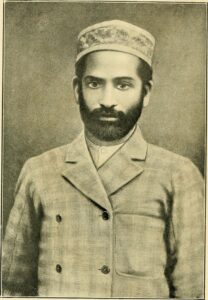
Compiled and Edited by
Professor Ram Prakash
The Kusumlata Arya Pratishthan
4/42, Sector5, Rajendra Nagar, Sahibabad-201005, Ghaziabad
ORIGIN OF THOUGHT AND LANGUAGE
“Vedas…trac(e) the history of human speech and thought
It is necessary to say something about the origin of language, which presupposes almost simultaneously with it the origin of thought. Language, as Aristotle calls it, is but the outward thought, and thought is the inward language. Both of them are logos. Wherever a word exists in any language, the corresponding thought is sure to exist, and a thought has no clear and distinct shape in the mind of the thinker, unless it is fixed in a word.
So the thought and language of man grew simultaneously, and our surest method of tracing the thought of man to its very root is to trace the history of human speech. Herein Ues the greatest importance of the Vedas. They supply us with ample material for tracing the history of human speech and thought to its very origin. And inasmuch as they give us this when and how of the origin of all human thought; they have a right to be called the revelation. No other existing book can satisfy this condition, and can, therefore, be no revelation. But where then did language come from? This theory of revelation will lead us in the right direction.
It is well known that the Indian grammarians call the alphabetical sounds of the Sanskrit language the akshara Samanmoya. This means the Veda, i.e., the revelation which consists of literal sounds. In other words according to the Hindu theories of revelation, which we have seen to be the only true one, these literal sounds are  the eternal sounds of nature. The origin of the articulate speech of man which is made of these literal sounds is in the sounds of nature. And this every body will acknowledge if he examines carefully the roots of the Sanskrit language, out of which have been formed, as Yaska and Shakatayana tell us, all the norms and verbs, &., of the language. The roots are the sounds which man learned to imitate from nature, and out of these by—and—by grew the language which is now our pride, as also did its sister languages. For sometime men used to talk only with roots, as they could not have done otherwise. And these roots expressed single ideas. When man had progressed so far that the combination of two single thoughts became a necessity of his life, two roots expressing the two different ideas were placed side by side. For better understanding, I give an illustration from a later process in the formation of language, the composition of nouns and from the English language, which will be more familiar to the reader. The word kingdom means the house or dominion of a king. Before their composition, both of these words conveyed a separate and independent idea. When the necessity was felt of expressing an idea compounded of these two, these words were placed side by side. But dom did not as yet lose its independence, and carried to the mind of the speaker, as before, the idea of a separate power. By and by, however, it became dependent on king, and lost its separate and independent power. In fact it became to borrow an expressive idea from the Chinese grammarian empty. Hence forward it was only a mere suffix, and nothing more.
The same happened with the last of the roots which we have seen were placed side by side in the begiiming of the second stage in the development of language. Thus, for example, the two roots  (to howl) and
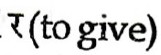 were placed when it became a necessity to express the compound idea of a being, which gave that sent the rolling sound of thunder. This gave us the word
 The word is a compound very similar to the later
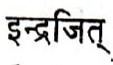 which literally rendered only is “Indra -win,” the high accent being on the word
 Indra. But the principal idea being that of the root rud
 , the other became very soon empty, and was reduced to a mere suffix, giving to the root the idea of agency just as in the word
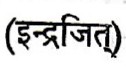 Indrajit. Having thus far explained the process of the formation of nouns I may leave the rest, for here I shall only have to do with nouns. One thing let us remember now. It is that in order to understand any thought properly, we must trace the word which is its outward representative to its root, and thence form the radical meaning to trace all the intermediate steps to the then meaning of the word. Then only shall we find what were the sensuous beginning of all our ideas, i.e., their true revelation. But we must have light-houses to guide our courses in this dark ocean of linguistic investigation. There must be some intermediate Link that may give us some clue at least to the origin and development. And that light house, that link, is supplied by the Veda. There we see the ideas growing and coming out, and in asmuch they are the only existing revelation.
THE NAMES OF THE VEDA EXPLAINED
Revelation in Sanskrit is called either the Shruti, the Amnaya, or Sumamnaya, and the Veda. I have explained the meaning of Shruti. It means the voice of nature. When these voices have done their work, man has come to know something, to possess all those ideas which he could not have possessed without them; then this Shruti becomes the Veda, inasmuch as it is now known. The word Amnaya comes from the root  to mediate upon, with the prefix
 , on all sides, and the suffix
 . It means that which ought to be thoroughly mediated upon. And indeed it is only by a thorough and critical examination of the Samhitas that we can reach in that mass of song to revelation true. This Veda is quite independent of the Samhitas. It will exist all the same, whether they exist or not. But if the Samhitas be lost, it will become difficult for us to recover the true Veda; for it is to be found in them alone, as their names themselves testify. The Samhitas are called respectively the Rig Veda, the Yajur Veda, &c. The meanings of these are the following: — The Rig Veda means a book, a collection in which the Veda is found in the Richas or praises; the Sama Veda means that in which the Veda is on the Samans or chanting hymns; and so on. With this meaning these books are in a figurative sense, sometimes simply, spoken of as the Vedas; but their true names are simply the Rik, the Saman &c., or, the Rig Veda, the Sama Veda, &c.
Thus we see that in reality the Veda cannot be a book, it cannot even be articulate speech. The true Veda is rather a matter of feeling and knowing. And that feeling and that knowledge the Samhitas give us in a very tangible form.