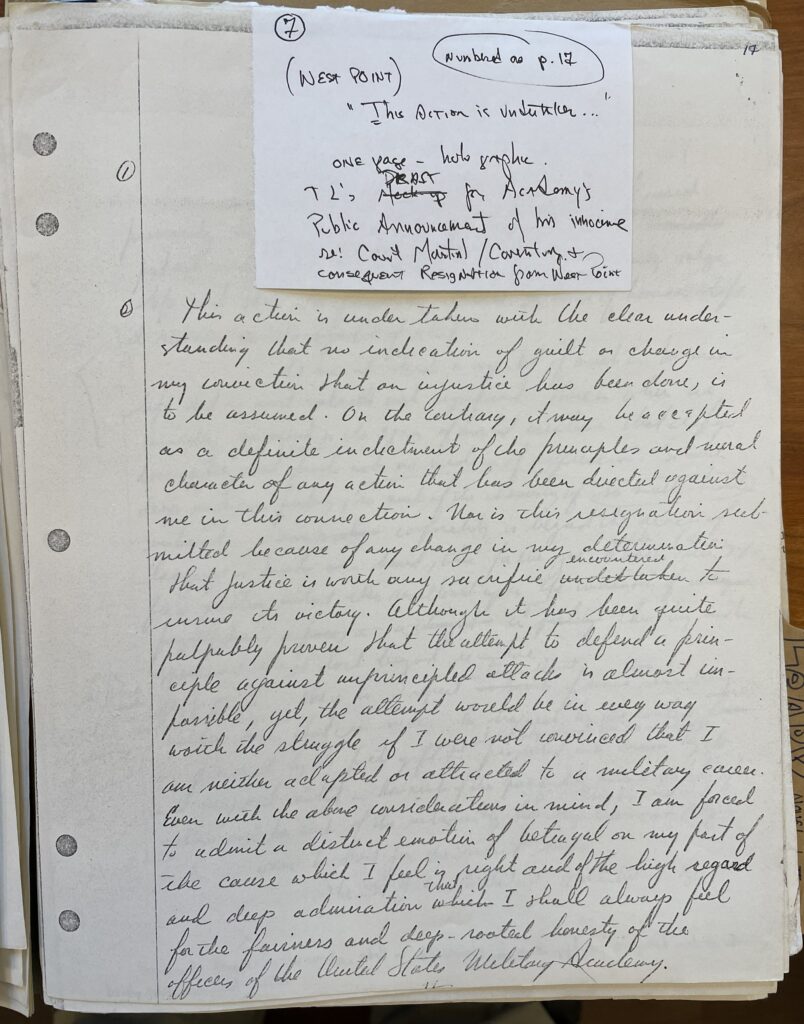
Timothy Leary
West Point Resignation Letter
(handwritten letter below)
February 1941
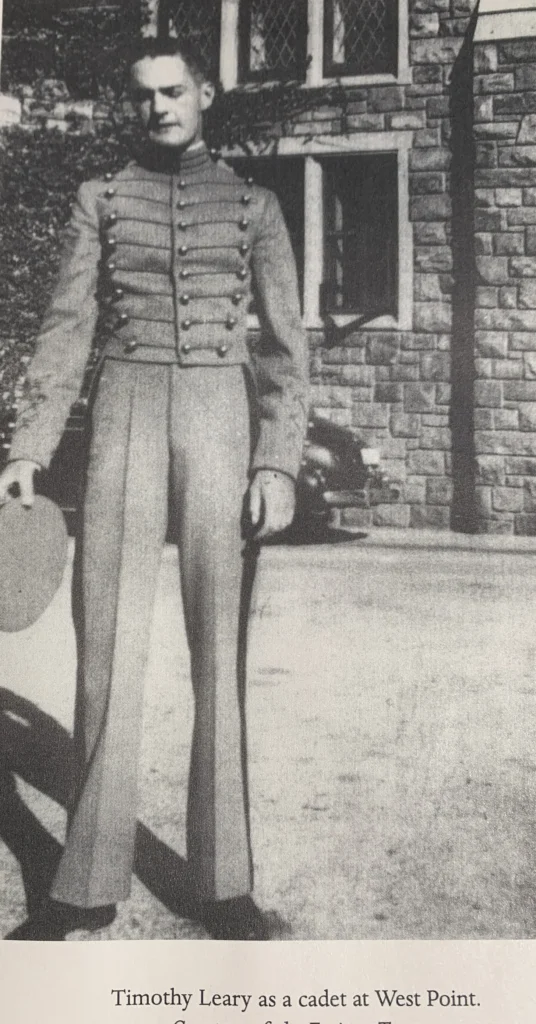
The Letter (handwritten below)
Timothy Leary
This action is undertaken with the clear understanding that no indication of guilt or charge in my conviction* that an injustice has been done, is to be assumed. On the contrary, it may be accepted as a definite indictment of the principles and moral character of any action that has been directed against me in this connection. Nor is this resignation submitted because of any change in my determination that justice is worth any sacrifice encountered to ensure its victory. Although it has been quite palpably proven that the attempt to defend a principle against unprincipled attacks is almost impossible, et, the attempt would be in every way worth the struggle if I were not convinced that I am neither adapted or attracted to a military career. Even with the above considerations in mind, I am forced to admit a distinct emotion of betrayal on my part of the cause which I feel is right and of the high regard and deep admiration that I shall always feel for the fairness and deep-rooted honesty of the officers of the United States Military Academy.
*Honor Committee inquiry—often characterized as a quasi–court-martial—**for allegedly drinking alcohol on a train returning from New York and failing to report fellow cadets.
Leary was accused of, on Saturday, November 2, 1940, after a match, purchasing four half-pints of whisky, which he shared with senior cadets on the train ride home, and subsequently failing to show up the next morning, which led to an inquiry.
When asked to explain, he admitted the drinking but did not mention that he had supplied the alcohol—insisting that he behaved ethically and refusing to resign, which would have been a terrible disappointment to his mother. Was he made a fall guy? Was there something in his demeanor that antagonized his seniors? Drinking alcohol was part of cadet life—among both plebes and seniors—and was regarded as only an infraction of regulations as long as one got away with it.
The Honor Committee found him guilty of lying and being defiant and decided to silence him. In February 1941, he was allowed to present his case to the court-martial. After two minutes, the court declared him innocent.