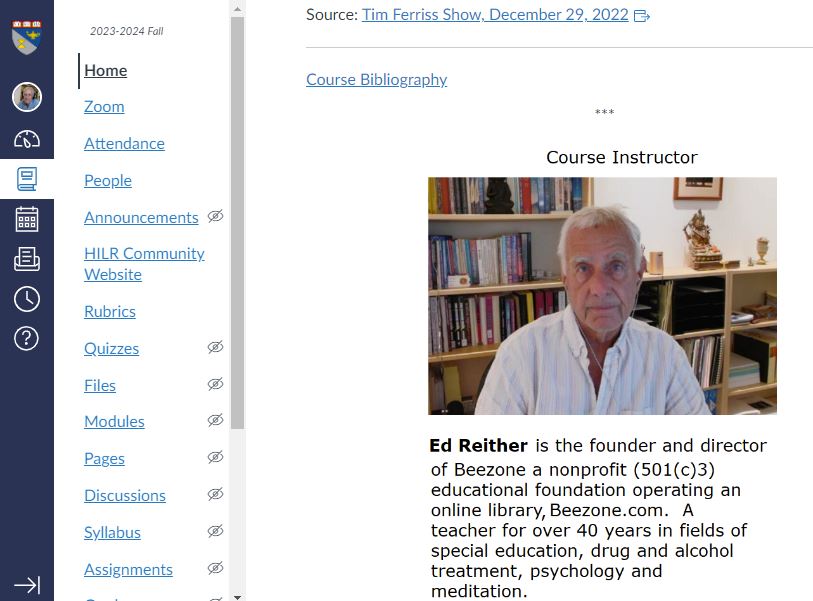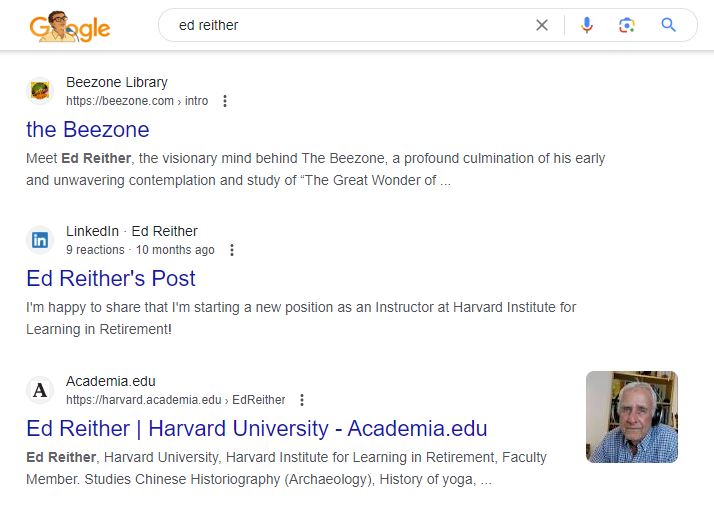

Ed Reither


Ed Reither – October 2025

Ed Reither (Edward J. Reither) is an educator, counselor, author, and the founder and visionary behind Beezone, a nonprofit 501(c)(3) educational foundation and digital library. Since his discharge from the U.S. Army in 1968 and the completion of his degrees in Education and Special Education, Ed has dedicated his professional life to the study and practice of human development, education, and spiritual psychology.

For over five decades, he has worked in a wide range of educational and therapeutic settings—including residential treatment centers, alternative education programs, state psychiatric hospitals, and drug rehabilitation organizations—helping individuals navigate emotional and personal growth. His experience extends beyond conventional education into spiritual and philosophical inquiry, drawing from both Eastern and Western traditions.

Ed’s intellectual and spiritual development has been shaped by rigorous study and direct association with influential teachers and thinkers such as Donald Hanks, Stephen Ambros, Nicholas J. Long, Alan Watts, Chögyam Trungpa Rinpoche, and Adi Da Samraj, among others.

Through Beezone, Ed continues to curate, interpret, and share wisdom from diverse traditions, offering a bridge between ancient insight and modern understanding for readers, students, and seekers worldwide.

At 80 years old, Ed Reither remains active and creative—most recently (2025) publishing The Harvard Psilocybin Project 1960–1963. Not a conventional scholar, but a scribe in the ancient sense—a translator and interpreter—Ed’s work is devoted to the field of wisdom, rendering complex spiritual and philosophical insights accessible to contemporary readers and seekers.

Unlike traditional academics who construct intellectual frameworks before experience, Reither’s path was experiential before theoretical. His journey began not with books, but with a direct realization of the limitations of mind—the paradox of duality, the futility of conceptual certainty, and the circular nature of thought. This formative insight, emerging through personal exploration long before formal study, became the foundation of his lifelong inquiry.

Much of Ed Reither’s work has been carried out quietly within the halls of major university libraries, immersed in rare texts, forgotten commentaries, and esoteric sources. Beginning in 1974 at the Tulane University Library, continuing at the Naropa Institute under Chögyam Trungpa Rinpoche in 1975, and later through independent research at Harvard University’s libraries in Cambridge, Massachusetts, Reither engaged theology, philosophy, and psychology not to master knowledge but to understand how others have wrestled with existential truth. The culmination of this lifelong pursuit is Beezone—a living, non-institutional archive dedicated to preserving, interpreting, and transmitting wisdom across cultures, traditions, and generations.

Beezone is not for the casual reader. Its depth and esoteric scope—especially within the Adi Da collection and the extensive Stacks directory—demand a committed and contemplative mind. Reither’s role as a Scribe—marked by decades of rigorous inquiry, translation, and reflection—reveals that casual readers may “not get it.” The material resists passive consumption; it challenges habitual thought and invites direct engagement with enduring questions of awakening, meaning, and existence.

From Reither’s observation, drawn from decades of dialogue and teaching, transformation arises not through argument but through the collapse of certainty—when one’s intellectual frameworks fail and a deeper inquiry begins. For those willing to cross that threshold, Beezone offers a transformative journey—a space of insight rather than ideology, guided by Reither’s vision as a Scribe who “plays the game of wisdom well,” not to impose answers, but to illuminate pathways toward genuine understanding.


“I write as a Scribe not a scholar“*

Ed Reither

Larkspur, California
July, 2025


*Nor do I write as a scholar, otherwise I would wisely barricade myself behind the safe walls of my specialism and not, on account of my inadequate knowledge of history, expose myself to critical attack.

Answer to Job, Psychology and Religon: West and East, CW 11., Carl Jung