Read PDF
Read Online
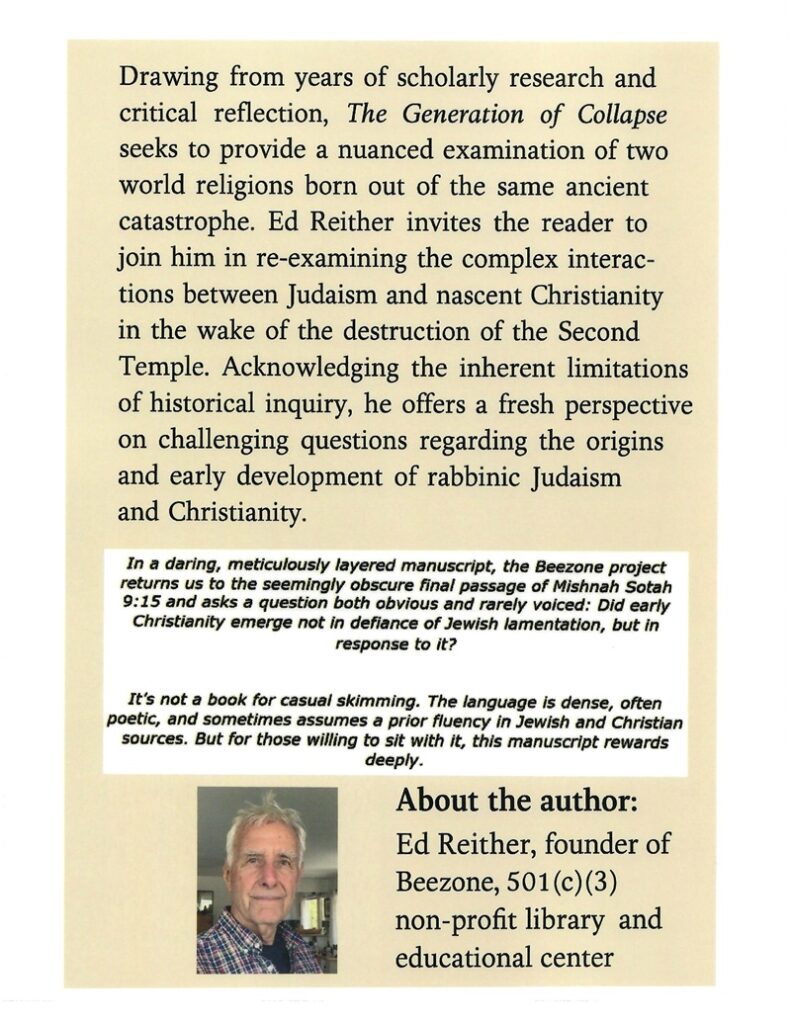
The Generation of Collapse
A Study of Mishnah Sotah 9:15 and the Emergence of Christianity
By
Ed Reither, Beezone
2025
“Upon whom shall we rely? Upon our Father in heaven”
“The wisdom of scribes will putrefy… and the truth will be absent”
“The Divine Spirit leads to the resurrection of the dead”
Mishnah 9:15
Table of Contents
Preface – vi
Foreword – vii
Introduction: Framing the Crisis – vii
Chapter One: The Babylonian Talmud – 1
Chapter Two: Rabbi Judah haNasi: Lawgiver at the Crossroads of Empire – 5
Chapter Three: Judah haNasi and the Transformation of Oral Tradition – 12
Chapter Four: When Writing Became Necessary – 16
Chapter Five: The Limits of Writing – 20
Chapter Six: How Rabbinic Tradition Shaped Legal Genius – 26
Chapter Seven: Why Rabbinic Judaism Did Not Fully Embrace Speculative Philosophy – 30
Chapter Eight: Rabbinic Judaism and the Hellenistic Challenge – 35
Chapter Nine: Mishnah Sotah 9:15 – 40
Chapter Ten: Mishnah Sotah 9:15 and the Crisis of Jesus’ Era – 43
Chapter Eleven: From Temple to Person – 47
Chapter Twelve: One Among Many? – 50
Chapter Thirteen: Mishnah Sotah 9:15 and the Historical Matrix of Christian Emergence – 55
Chapter Fourteen: Invitation: Toward the Inner Ladder of Israel’s Wisdom – 64
Chapter Fifteen: Epilogue – 65
Chapter Sixteen: Appendix: Mishnah Sotah 9:15 – 66
Chapter Seventeen: Glossary – 69
Preface: On Knowing, Remembering, and Writing with Machines
My journey into the origins of Christianity and its emergence from the ancient Hebrew world began with a simple desire: to understand. As I delved into the New Testament and numerous books on early Christianity, I found myself increasingly unsatisfied with the narratives presented. Too often, these accounts relied on what I came to see as storytelling—persuasive, sometimes beautiful, but not always grounded in rigorous historical investigation.
This realization led me on a quest for deeper understanding, one that took me through university libraries, graduate courses, and countless conversations with scholars, historians, and religious voices—Jewish and Christian alike.
Writing on any subject requires a certain assumption: that one knows something about the matter at hand. That’s why people defend dissertations and why teachers teach. But I must confess, in all honesty, that I know very little—certainly not in any final or authoritative way—about the subject matter in this book. I wasn’t alive during the period it describes, and neither were the fifty or so authors whose works I reference throughout these pages.
The truth is, we all write by reading others—who themselves read others, who in turn were reading others. Visit any serious library and look at the shelves devoted to the origins of Christianity or Second Temple Judaism. You’ll find not dozens, but hundreds—perhaps thousands—of books, each offering its own interpretation, its own piece of the puzzle. To truly master them all would be a lifetime’s work, if it were even possible.
But what you won’t find in all those volumes is the particular thread that runs through this book, or the unique way in which that thread was communicated and formed.
Can you recall what happened yesterday? Last week? Last year? Can you remember everyone present at your wedding—or what they said to you? Try reaching back into early childhood, before you had words for things, before you could even interpret what was happening. Much of what we think we know about our own lives is shaped by what others told us. The same is true—intensely so—when we speak of events two thousand years ago.
Despite the confidence with which many historians write, much of our knowledge about the ancient world is secondhand, fragmentary, or reconstructed centuries after the fact. The documents we rely on were often composed in different languages, from vastly different cultural perspectives, and often with theological or political agendas.
This book, then, does not claim to present definitive truths. It is not an argument from authority, but a personal investigation—a critical exploration of the period, place, and context out of which Christianity emerged. My focus centers on Mishnah Sotah 9:15, a terse and potent line of rabbinic text that, I believe, casts new light on the crisis from which both Rabbinic Judaism and early Christianity arose.
But I must also make another confession—one fitting for our own time.
Yes, I used ChatGPT to help write most of this article—but not without going over everything carefully, editing where needed, and making sure it reflects my own understanding. I see AI, like ChatGPT, as a helpful reference tool—something like a very fast and well-read assistant. But I don’t rely on it to form my conclusions.
The ideas and viewpoints in this piece come from my own work—years of research, reflection, and conversations, both written and lived. ChatGPT helped shape the wording and structure, but the meaning and direction come from me.
Some of what you read may feel unusually fluid or structured, and that is in part because of this collaboration. But the guiding impulse behind this work is deeply human: to understand what shaped us, and to invite others into that process. This book would not exist without AI—but it also would not exist without me.
If you can receive the book on those terms, then I welcome you.
Let us begin.
Ed Reither
Foreword
The Generation of Collapse
How an Ancient Crisis Created Two World Religions
Introduction Part II: When Everything Falls Apart
In the year 70 CE, the unthinkable happened. The Second Temple in Jerusalem—centerpiece of Jewish religious, cultural, and national life—was reduced to ash and rubble by the Roman army. Along with it fell the priesthood, the Sanhedrin, and the symbolic architecture of a world that had stood for centuries. For the Jewish people, this was more than just the loss of a building. It was the collapse of the entire framework through which they had related to God, to law, and to one another.
And yet, what followed was not erasure. Against all odds, from the wreckage of this catastrophe emerged not silence, but speech. Not a disappearance, but a rededication—to words, to memory, and to the enduring covenant of Torah. From the ruins of Temple-centered religion, Judaism began to transform. It rebuilt itself around study and law, prayer and commentary. It became, in time, what we now call Rabbinic Judaism.
But it was not alone. From this same historical trauma came another path, one that looked at the same signs of decline and arrived at a radically different conclusion. That the Messiah had already come. That the covenant had been fulfilled. That a new kingdom had begun. This path became Christianity.
This book explores that dual emergence—not through the lens of later theology, but by returning to a single, haunting text composed in the wake of the Temple’s fall: Mishnah Sotah 9:15. In this brief but devastating passage, the rabbis list all that has vanished—the poets, the sages, the holy men, the spirit of prophecy. The world they describe is unraveling. And yet, buried in its final line—“Upon whom shall we rely? Only upon our Father in Heaven”—is not only a cry of despair, but a blueprint for survival.
The Generation of Collapse invites the reader into this moment of profound reckoning. It is a meditation on endings and beginnings, on how two great traditions arose from the same loss, and how both continue to carry its echoes to this day.
A Few Things to Know Before We Begin
The Second Temple
Imagine if the Vatican, the U.S. Capitol, and the Metropolitan Museum were all one building—and then imagine losing that building in a single day. That’s the scale of what the Second Temple meant. It wasn’t just a religious site—it was the center of Jewish identity, authority, and memory.
The Second Temple:
- As the central place of worship and ritual for Judaism, the Second Temple held immense theological, political, and cultural significance. It was not just a religious site, but the literal and symbolic heart of Jewish identity and nationhood.
- The Temple housed the Ark of the Covenant, which contained the tablets of the Ten Commandments, as well as the Holy of Holies – the most sacred space where the divine presence was believed to dwell.
- It was the site of daily sacrifices, festivals, and pilgrimage for Jews from across the ancient Mediterranean world. The loss of this central gathering place was profoundly disruptive.
- Architecturally, the Second Temple complex was an impressive feat of engineering and design, covering over 35 acres and rising hundreds of feet. Its destruction was a catastrophic blow to Jewish pride and self-determination.
The Oral Torah
Jews believed that God gave Moses not only a written law (the Torah), but also an oral tradition: an intricate web of interpretation, commentary, and lived teaching, passed down from teacher to student. It was vibrant, dynamic—and entirely unwritten.
The Oral Torah:
- The Oral Torah represented the dynamic, interpretive tradition of Judaism that developed alongside the written Torah (the first five books of the Hebrew Bible).
- It encompassed legal rulings, ethical teachings, scriptural exegesis, and the practical application of God’s laws in daily life. This living tradition was seen as integral to the full practice of Judaism.
- With the destruction of the Temple and the dispersal of the Jewish people, the transmission of this unwritten body of knowledge became increasingly fragile and endangered.
- Preserving the Oral Torah became a central preoccupation, eventually leading to its codification in the Mishnah and Talmud to ensure its survival.
The Crisis
- The loss of the Temple upended the entire religious and social infrastructure of Judaism, leaving the Jewish people to grapple with fundamental questions of identity, practice, and connection to God.
- Without a central place of worship and sacrifice, Jews had to rethink the nature of their relationship with the divine and the means of atonement and connection.
- The disruption of the traditional methods of Torah transmission also created an existential crisis, as the dynamic, living tradition of Judaism was at risk of being lost.
- This period of upheaval and uncertainty paved the way for divergent responses, including the emergence of rabbinic Judaism and early Christianity, as different groups sought to redefine Jewish faith and practice.Top of Form
When the Temple fell, the Jewish people faced a staggering question:
How do you practice a religion built around a place that no longer exists?
How do you preserve a wisdom that lives only in memory when the teachers are gone?
Two responses emerged.
One group—led by visionary scholars known as rabbis—chose to write everything down. They reshaped Judaism into a portable, adaptable tradition centered on texts, study, and community.
Another group, which would come to be known as early Christians, believed that the answer to the crisis had already arrived in the form of a Jewish teacher named Jesus of Nazareth. They understood his death and subsequent resurrection as a divine turning point, a pivotal moment that fundamentally transformed the relationship between God and humanity. For these followers of Jesus, the Temple was no longer the essential locus of divine worship and atonement – his sacrifice had ushered in a new spiritual paradigm where the need for the Temple and its rituals had been transcended.
Why This Story Still Matters
Every generation faces moments when the old ways break down—when institutions fail, when certainty collapses, when the stories that once held a people together no longer seem to work.
What happened after 70 CE is more than a historical event. It’s a template for resilience, reinvention, and the deep human need to preserve meaning when everything familiar is swept away.
Judaism and Christianity did not spring from two separate worlds. They were born side by side, out of shared loss, shared yearning, and shared courage. They were responses to the same question: How do you keep the faith when the world you knew no longer exists?
This is that story.
In the chapters that follow, we’ll trace the foundational events and dynamics that shaped the tumultuous world in which rabbinic Judaism and early Christianity emerged. From the codification of the Oral Law under Rabbi Judah haNasi to the influence of Hellenistic thought, these chapters document a profound period of flux, as the Jewish people grappled with questions of identity, authority, and spiritual survival in the aftermath of the Temple’s destruction.
Against this backdrop of upheaval, we’ll explore how Jewish legal reasoning, cultural memory, and resilient faith evolved into enduring forms. But at the heart of this story lies a profound question: when the very foundations of your world have crumbled, how do you choose between preserving the past and embracing a radically new path forward?
In the final chapter, we’ll turn our focus to a single, pivotal text – Mishnah Sotah 9:15 – which holds the key to unlocking the competing visions for Judaism’s future that gave rise to both rabbinic Judaism and early Christianity. Through a close analysis of this text, we’ll gain deeper insight into the crisis of Jewish leadership, law, and priesthood, as well as the fertile soil in which the Christian movement took root.
Ultimately, this chapter will argue that both rabbinic Judaism and Christianity represent legitimate, if radically different, responses to a shared trauma. Where one camp clung fiercely to the hallowed traditions of Torah, the other proclaimed the shattering arrival of divine redemption. And where one preserved the tension of divine absence, the other announced the immediacy of divine presence.
By tracing this momentous transformation, we’ll uncover not just a chronicle of the past, but a timeless template for resilience, reinvention, and the human drive to find meaning amidst the ruins of a collapsing world.
Introduction
At the edge of a spiritual and historical abyss, a single passage echoes with the grief of a world unraveling. Mishnah Sotah 9:15, composed in the shadows of Rome’s destruction of the Second Temple, is no ordinary text. It is a dirge—a quiet and unflinching lament over the disappearance of wisdom, the fading of virtue, the silence of prophecy. The center of Jewish life has collapsed: the Temple lies in ruins, its priesthood shattered, its legal authority dissolved.
And yet, from within this collapse, something extraordinary begins to stir.
This book begins at that threshold. It listens carefully to the voices embedded in Mishnah Sotah 9:15—not only as a record of despair, but as a map of transformation. For while the sages who composed this lament looked out over a world seemingly ending, their words unknowingly trace the outlines of a new beginning.
What emerges is not one future, but two.
One future bends inward, conserving what can be preserved. It becomes Rabbinic Judaism, centered not on place but on practice, not on altar but on law, not on power but on perseverance. The other future moves outward—announcing that the messianic age has come, that the covenant has been fulfilled, and that through the person of Jesus, a new kingdom has begun. This future becomes Christianity.
Mishnah Sotah 9:15, then, is not just a lament. It is a hinge—a place where Jewish history folds, fractures, and is reborn in two directions. It does not explain these futures directly, but it provides the spiritual atmosphere that made them possible.
This book is an invitation to re-read that moment: not just through the lens of tragedy, but as a generative crucible. It draws on centuries of Jewish and Christian interpretation, weaving theology and history together to show how one cry—“Upon whom shall we rely? Only upon our Father in Heaven”—could echo through the ages as both surrender and strategy.
It is in this tension—between collapse and continuity—that the spiritual legacies of both Rabbinic Judaism and Christianity took shape.
And it is here, perhaps, that they might once again be understood not as enemies, but as estranged siblings born from the same grief.
Chapter One: The Babylonian Talmud
A Living Archive of Jewish Thought
The Babylonian Talmud is not just a book—it’s more like a city. A sprawling, centuries-old city of voices: sages debating across generations, memories echoing through law, mysticism, and logic. It’s less a single statement than an ongoing conversation—unfinished, alive.
Developed between 200 and 500 CE in the Jewish academies of Babylonia—centers like Sura, Pumbedita, and Nehardea—the Talmud became the spiritual engine of a people learning to live in exile. It is, in many ways, the Jewish answer to catastrophe: not a rebuilding in stone, but a rebuilding in speech, meaning, and tradition.
At its heart lies the Mishnah, compiled around 200 CE by Rabbi Judah haNasi. This was the first great act of preservation: the oral teachings that had once been passed from mouth to ear, generation after generation, were written down. The Mishnah formed the foundation.
Then came the Gemara—not simply a commentary, but a vast, unfolding web of interpretation and creative inquiry. Where the Mishnah offered structure, the Gemara brought movement. Together, they form the core of every Talmudic page.
In classical editions, the Talmud page is a visual labyrinth. Around the central column of Mishnah and Gemara are marginal notes and medieval glosses—from minds like Rashi and the Tosafists—each weighing in, clarifying, and preserving. It’s a palimpsest of generations—a living document of communal memory.
The Babylonian Talmud explores 37 of the Mishnah’s 63 tractates, focusing on civil law, Sabbath observance, Temple service, and religious practice. It largely leaves aside agricultural laws and ritual purity—topics more relevant to the Land of Israel—but it opens up a world of thought that could survive anywhere.
Where the Temple had been rooted in one place, the Talmud could travel. Where priests had once stood in stone courtyards, now scholars stood over pages. It became the portable homeland of the Jewish people—a place where law, faith, and imagination could continue to grow, even in exile.
Dialectic and Devotion
Reading the Talmud is not a casual endeavor. Its arguments are complex, its structure circular, and its allusions often obscure. But this difficulty is integral to its purpose. The Talmud was never meant to provide simple resolutions. It invites the reader into a landscape to be explored through repeated engagement, discussion, and reflection.
For the rabbinic tradition, study was a sacred discipline. Learning was a way of life, and even disagreement was considered devotion. Dispute and debate were not threats—they were reverent engagement with divine will.
The Talmud does not shy away from existential questions: What constitutes justice? How do we interpret divine intention? How should we understand suffering? Yet, rather than offering fixed answers, it keeps the conversation alive. It teaches a way of being that remains open—rooted in tradition, but never rigid; anchored in memory, but not confined by it.
This is not confusion or indecision. It is humility. The Talmud cultivates a reverent form of not-knowing, where the search itself becomes sacred. The willingness to stay with the question becomes an act of spiritual depth.
This interpretive model allowed Judaism to endure after the loss of the Temple. No longer centered in one place, the tradition found continuity in a method: a way of living that values inquiry, sustained by learning and faith.
Babylonian vs. Jerusalem Talmud
The Talmud comes to us in two distinct forms—each shaped by its geography and historical conditions: the Jerusalem Talmud (Talmud Yerushalmi) and the Babylonian Talmud (Talmud Bavli).
The Jerusalem Talmud was completed around 400 CE in the land of Israel. Its tone is terse and fragmented, reflecting Roman persecution and instability. Discussions are compressed, shaped under pressure.
By contrast, the Babylonian Talmud, completed about a century later, emerged from the Jewish communities of Babylonia. There, academies like Sura and Pumbedita thrived in a more stable setting. The result is a more expansive and discursive Talmud. Arguments unfold with elaboration, revisiting earlier points and weaving broader frameworks.
Both Talmuds use the Mishnah and draw from similar teachings. Yet their tone and method differ markedly. The Jerusalem Talmud is elliptical; the Babylonian Talmud is richly dialectical.
Over time, the Babylonian Talmud became the central pillar of Rabbinic Judaism. Its legal authority and intellectual style shaped religious education and discourse for centuries. Though different in texture, both Talmuds reflect a common goal: to preserve and renew Jewish life after catastrophic loss.
Tradition in Translation
For much of Jewish history, the Talmud served as the core of intellectual and spiritual life. Though difficult and dense, it was studied, built upon, and expanded.
Figures like Rashi, Maimonides, and Yosef Karo helped clarify and interpret the Talmud, extending its influence and complexity.
In the modern era, translations and commentaries opened access. Editions by Soncino, Steinsaltz, and Schottenstein enabled wider participation. Rodkinson’s early 20th-century edition, though controversial, marked a key step in the Talmud’s move into print culture.
Today, platforms like Sefaria.org offer digital access. The Talmud can now be explored on screens, making its wisdom globally available.
Despite technological changes, the essential practice endures: questioning, interpretation, and engagement. The medium evolves, but the conversation lives on.
Speaking Through the Silence
Reading the Babylonian Talmud is not just legal study; it is immersion into a world where questions are sacred. Though a book of law, it is also filled with ethical dilemmas, speculative thought, and complex tension. It doesn’t resolve every issue—it preserves it.
This method shaped not only Jewish law, but Jewish spiritual life. It models an approach that values complexity, humility, and the search for truth.
As we turn to Mishnah Sotah 9:15, we do so not simply to study history, but to examine how Jewish thought responds to trauma. The Talmud doesn’t offer consolation—it offers inquiry. Where the Mishnah mourns collapse, the Talmud seeks meaning.
This is how the tradition survives—not by erasing grief, but by transforming it into depth and understanding.
Bibliography
Primary Texts and Classical Sources
- Babylonian Talmud. Translated by Michael L. Rodkinson. Boston: The Talmud Society, 1918.
- The Mishnah. Translated by Herbert Danby. Oxford: Oxford University Press, 1933.
- Maimonides. Mishneh Torah. Various editions and translations.
- Rashi. Commentary on the Babylonian Talmud. 11th century CE.
- Tosafot. Glosses on the Babylonian Talmud. 12th–14th centuries CE.
Modern Editions and Translations
- Steinsaltz, Adin. The Talmud: A Reference Guide. Translated by Edward Levin. New York: Random House, 1989.
- Scherman, Nosson, ed. The Babylonian Talmud: The ArtScroll Series. Brooklyn, NY: Mesorah Publications, 1990–present.
- Epstein, I., ed. The Babylonian Talmud: English Translation. London: Soncino Press, 1935–1952.
Historical and Analytical Studies
- Halivni, David Weiss. The Formation of the Babylonian Talmud. New York: Oxford University Press, 2013.
- Rubenstein, Jeffrey L. The Culture of the Babylonian Talmud. Baltimore: Johns Hopkins University Press, 2003.
- Neusner, Jacob. Invitation to the Talmud: A Teaching Book. San Francisco: Harper & Row, 1984.
- Boyarin, Daniel. Socrates and the Fat Rabbis. Chicago: University of Chicago Press, 2009.
- Hayes, Christine. What’s Divine About Divine Law?: Early Perspectives. Princeton: Princeton University Press, 2015.
Chapter Two
Rabbi Judah haNasi: Lawgiver at the Crossroads of Empire
If the destruction of the Second Temple in 70 CE fractured Jewish religious and communal life, Rabbi Judah haNasi played a central role in its reconstruction. Yet his work of rebuilding was not done with stone or ritual—it began with the act of writing.
At a time when the Jewish people were dispersed, politically weakened, and uncertain about their future, Judah made a choice that was both innovative and deeply rooted in tradition. He took the Oral Torah—the body of teachings, debates, and legal rulings transmitted from teacher to student—and set it down in written form.
This effort did not take place in the spiritual and political center of Jerusalem, but in the Galilee, a region marked by cultural and imperial complexity. The Galilee was a stronghold of Jewish life, but it was also embedded within the Roman world. Cities like Sepphoris, where Judah eventually lived and led, reflected this tension. Roman amphitheaters, courts, and temples stood alongside synagogues. Latin inscriptions and Hellenistic customs coexisted with Jewish observance. Roman roads and currency were part of daily life.
Judah navigated this environment with insight and pragmatism. He did not resist Roman rule with violence or open defiance. Instead, he operated within it. As Nasi—a title that conferred both spiritual leadership and administrative authority over Jewish affairs—Judah exercised influence in ways that were both strategic and stabilizing.
Historical sources and rabbinic tradition suggest that Judah cultivated relationships with the Roman elite. Some accounts even describe a close friendship with a Roman emperor, referred to as “Antoninus,” possibly a symbolic or semi-historical figure based on emperors like Marcus Aurelius or a member of the Severan dynasty. Whether these stories are literal or not, they reflect Judah’s approach: he was not seeking to overthrow the empire but to secure space for Jewish life within it.
His most enduring achievement was the compilation of the Mishnah. This was not merely an archival project or an effort to preserve tradition in the face of decline. It was a decisive act of cultural continuity. Judah recognized that while empires may fall, texts endure. A tradition held only in oral memory can disappear with the passing of a generation. But one that is written can survive dispersion and travel across time and geography.
By organizing and redacting centuries of legal discourse and rabbinic teaching, Judah created a foundation for Jewish life in the post-Temple world. The Mishnah became the cornerstone of Rabbinic Judaism, eventually forming the central text around which the Babylonian and Jerusalem Talmuds were built.
In doing so, Judah made more than a scholarly contribution. He helped reorient Jewish identity. His work affirmed that Judaism would not perish with the destruction of the Temple. Instead, it would continue as a faith rooted in study, interpretation, and written tradition. With the Mishnah, Judah helped shape a new reality: the transformation of Judaism into a people defined not by land or sanctuary, but by the enduring authority of its sacred texts.
Among Philosophers and Emperors
Judah haNasi and the Wisdom of the Age
Rabbi Judah haNasi lived during a time of profound political and intellectual change. He was not isolated from the broader currents of the Roman world but stood at a unique intersection of Jewish tradition and Greco-Roman thought. His work emerged not only from the internal concerns of the rabbinic community but also in response to the collapse of Jewish political autonomy and the shifting landscape of philosophical inquiry in late antiquity.
While Judah’s primary dialogue was with his fellow rabbis—the legal thinkers and teachers whose voices fill the Mishnah—he was also a contemporary of major intellectual figures of the Greco-Roman world. Among these was Galen, the influential physician and philosopher, who sought to systematize both the workings of the body and the moral life of the soul. Galen’s ambition to organize knowledge resonates in Judah’s own effort to structure Jewish law and practice through the Mishnah.
Marcus Aurelius, the Stoic emperor, wrote his Meditations during Judah’s lifetime—a personal reflection on virtue, mortality, and inner discipline. Though written in a different idiom, these meditations share an underlying concern with continuity, ethical self-control, and the meaning of human life, concerns that also shaped Judah’s work.
Soon after Judah’s era, Plotinus would develop the mystical vision of Neoplatonism, emphasizing the soul’s ascent toward unity and transcendence. While rabbinic theology did not mirror Neoplatonic metaphysics, both traditions grappled with the nature of divine reality, the structure of existence, and the inner refinement required to approach the sacred.
Even the literary efforts of figures like Aulus Gellius, whose Attic Nights sought to preserve cultural fragments from a disappearing classical world, bear a faint resemblance to Judah’s own task. Though the Mishnah is far more rigorous in its purpose and form, it too serves as a cultural safeguard—ensuring that the teachings, laws, and ethical insights of Jewish tradition would not be lost in an age of upheaval.
Judah haNasi was not a Hellenist in the sense of adopting Greek philosophical systems. He did not teach Plato or Cicero, nor did he attempt to synthesize Judaism with Stoicism or Neoplatonism. But he lived alongside Hellenistic culture and was shaped by its intellectual environment. In Sepphoris, the city where he led and taught, it is possible that his own court stood in close proximity to schools of Greek rhetoric and philosophy. The culture of public debate, structured argument, and disciplined inquiry was part of the world he inhabited.
Rabbinic tradition later records occasional debates with Stoics, Epicureans, and other philosophers. While these encounters often present the non-Jewish thinkers as opponents, they also reflect a shared engagement with enduring human questions: What constitutes a good life? How should one act in a world marked by loss and change? What does it mean to live with integrity and purpose?
Judah’s answer was rooted not in philosophical abstraction, but in a living tradition. The Mishnah he compiled was not an exercise in speculative thought but a code of practical, ethical, and spiritual guidance. It emerged from devotion—to a people, to a God, and to a covenant that had survived exile, destruction, and dispersion. In shaping the Mishnah, Judah offered a form of wisdom that was both ancient and adaptive—deeply grounded in tradition yet responsive to the intellectual and moral needs of his time.
The Silence on Christianity – What Judah Chose Not to Say
One of the most striking features of the Mishnah is what it leaves unsaid. Despite being compiled in a time when Christianity had grown far beyond its origins, the Mishnah makes no mention of it at all. By the late second century CE, Christianity was no longer a marginal movement. It had expanded throughout the eastern Mediterranean and established communities in cities and regions close to Judah haNasi’s own sphere of influence, including Galilee and other parts of Roman-controlled Judea.
Given this context, it is difficult to believe that Judah was unaware of Christianity’s presence. He lived in a cosmopolitan world and was in regular contact with both Jewish and Roman circles. As the patriarch of the Jewish community and the redactor of its most influential legal text, he would have had ample exposure to competing religious ideas and movements.
And yet, Christianity is entirely absent from the Mishnah. This omission has led scholars to question whether it reflects oversight, indifference, or intentional strategy. Most likely, it was the latter. Judah’s primary concern was not to engage external ideologies but to address the needs of a Jewish community reeling from historical trauma—especially the destruction of the Temple, the failure of the Bar Kokhba revolt, and the ongoing pressures of Roman rule.
Introducing polemics against Christianity—or even acknowledging it—could have deepened internal divisions or attracted unwanted scrutiny from Roman authorities, who were increasingly aware of the tension between Jews and the growing Christian movement. Judah’s silence, then, was likely a calculated decision: to preserve unity, to avoid political entanglement, and to focus attention inward on the core of Jewish life.
Rather than define Judaism in contrast to Christianity, Judah chose to reinforce Jewish identity through the continuity of halakhic practice. His goal was to restore a sense of cohesion and shared purpose through law, tradition, and study—not to provoke debate or refute rival doctrines.
Later rabbinic texts would take a different approach. They include cryptic references to heretics (Minim), veiled stories possibly aimed at Christian figures, and indirect responses to theological challenges. But these belonged to a later phase of rabbinic literature, when boundaries between religious communities had become sharper and more defensive responses were deemed necessary.
The Mishnah, by contrast, is notable for its restraint. It does not attempt to address external threats or controversies. It focuses on building from within—on preserving and transmitting a coherent Jewish tradition. Judah haNasi’s decision to omit any mention of Christianity reflects not weakness or ignorance, but a deliberate prioritization of community preservation over confrontation.
In doing so, he offered a different kind of response—one that emphasizes renewal rather than rebuttal. He showed that strength can come from clarity of purpose and that not every challenge needs to be met with direct engagement. Sometimes, the most enduring form of resistance is to build something resilient, meaningful, and self-sustaining.
Messiah and Law
Rabbi Judah haNasi lived during a period when the hope for a Messiah remained alive, but had taken on a different character. Following the devastation of Jerusalem and the failure of the Bar Kokhba revolt, the expectation of a divinely appointed redeemer did not disappear—but it was tempered by experience. The longing for a descendant of David who would restore Israel’s sovereignty continued, yet it was no longer the central focus of Jewish life.
Judah redirected that energy. His compilation of the Mishnah, the foundational text of Rabbinic Judaism, contains no dedicated discussion of the Messiah. There is no tractate outlining messianic prophecy or timelines, no extended reflection on apocalyptic visions or end-times deliverance. Instead, the Mishnah concerns itself with matters of daily life: sacrificial law, family relationships, ritual purity, civil obligations, and ethical conduct.
This shift did not reject messianic hope, but it grounded it. Judah’s message, implied through the structure and content of the Mishnah, was clear: the Messiah may come—but in the meantime, the community must continue to live responsibly and faithfully. Hope for the future was not abandoned, but it was redirected into sustaining a durable way of life.
Later traditions speculated that Judah haNasi himself might have been worthy of the role of Messiah, had the generation been meritorious. But Judah never made such a claim. His final words, according to tradition, were not declarations of status or power. He expressed concern for the character of his sons and for the preservation of humility and moral awareness after his passing.
Judah wielded considerable influence. As both a spiritual and political leader, he occupied a unique position in Jewish history. Yet he used that authority not for personal elevation, but to stabilize and transmit a legal and ethical tradition that could survive dispersion and disruption.
By focusing on legal structure and communal responsibility, Judah translated messianic longing into a sustainable form of Jewish resilience. His legacy was not a single moment of redemption, but a framework that enabled generations to endure, adapt, and continue. In turning eschatological hope into daily practice, Judah ensured that the Jewish people could live meaningfully—even while waiting for the fulfillment of promises yet to come.
A New Center Without a Temple
Rabbi Judah haNasi’s lasting contribution to Judaism was not only the compilation of the Mishnah, but the creation of a new kind of spiritual center. In a time when the physical heart of Jewish life—the Temple in Jerusalem—had been destroyed, Judah offered an alternative that was neither geographical nor political. He built a sanctuary made of text, a structure that could unify and guide the Jewish people in the absence of their traditional institutions.
Where there were once sacrifices, he provided structure. Where kings once ruled, he offered the law as a new source of authority. Rather than attempting to restore what had been lost, Judah reimagined what could endure in its place. His vision grounded Jewish identity not in physical space or political power, but in memory, legal discourse, and communal obligation.
Judah lived in a complex and pluralistic world. He shared his era with Stoic philosophers who meditated on virtue, Neoplatonists who pursued metaphysical unity, Roman officials who enforced imperial law, early Christians who preached a new covenant, and Hellenized Jews navigating multiple identities. Amid this diversity, Judah remained firmly rooted in Torah.
He understood a key truth that others often overlooked: Empires rise and fall, civilizations come and go, but law—especially when tied to a sacred tradition—can endure beyond the lifespan of any one culture or regime.
Judah did not claim to end Jewish suffering, nor did he offer promises of redemption. Instead, he gave his people the means to endure suffering with dignity and continuity. Through the Mishnah, he provided a shared language and framework that allowed a fractured and dispersed community to continue walking in covenant. The Temple was gone, but the center did not collapse. Through Judah’s work, it was rebuilt—not in stone, but in structure, study, and sacred commitment.
Bibliography
Rabbi Judah haNasi: Lawgiver at the Crossroads of Empire
Primary Jewish Sources
- The Mishnah. Translated by Herbert Danby. Oxford: Oxford University Press, 1933.
- The Mishnah. Translated by Jacob Neusner. New Haven: Yale University Press, 1988.
- Babylonian Talmud. Translated by Michael L. Rodkinson. Boston: The Talmud Society, 1918.
Greco-Roman and Philosophical Sources
- Aurelius, Marcus. Meditations. Translated by Gregory Hays. New York: Modern Library, 2003.
- Galen. On the Natural Faculties. Translated by Arthur John Brock. Cambridge: Harvard University Press, 1916.
- Plotinus. The Enneads. Translated by Stephen MacKenna. London: Faber and Faber, 1917.
- Gellius, Aulus. Attic Nights. Translated by John C. Rolfe. Cambridge: Harvard University Press, 1927.
Modern Scholarship and Historical Context
- Goodman, Martin. Rome and Jerusalem: The Clash of Ancient Civilizations. New York: Vintage Books, 2008.
- Halivni, David Weiss. The Formation of the Babylonian Talmud. Oxford: Oxford University Press, 2013.
- Neusner, Jacob. A Life of Rabbi Judah the Prince: Sepphoris and the Spiritual Policy of Rabbinic Judaism. Leiden: Brill, 1970.
- Rubenstein, Jeffrey L. The Culture of the Babylonian Talmud. Baltimore: Johns Hopkins University Press, 2003.
- Schäfer, Peter. Jesus in the Talmud. Princeton: Princeton University Press, 2007.
Chapter Three
From Voice to Form: Judah haNasi and the Transformation of Oral Tradition
The survival of Judaism after the destruction of the Second Temple was not secured through military strength, political power, or grand monuments. It did not depend on sovereignty or visible signs of triumph. Instead, it endured through memory—not memory as sentiment or nostalgia, but as a disciplined practice. This was a memory that was repeated, rehearsed, and preserved with care.
At the center of this practice was the Oral Torah, a living tradition transmitted through generations by word of mouth. It passed from teacher to student, embedded in the rhythm of conversation and debate. The Oral Torah was dynamic and responsive; it adapted as circumstances changed and as new questions emerged. It remained vital precisely because it was not static—it moved like breath through time.
But the reliance on oral transmission carried risks. By the second century CE, Jewish communities were not only scattered—they existed within dominant cultures that valued written permanence. Rome had destroyed their central place of worship. Hellenistic influence shaped their urban life. Christianity, meanwhile, had begun formalizing its own canon of sacred texts. In this shifting environment, the question was no longer just how to survive, but how to preserve continuity.
The solution was not to abandon the oral tradition, but to find a way to preserve its essential form. The goal was not to replace spoken transmission, but to record its framework so that it could still be revived and carried forward—even if the original voice had been lost. That framework became the Mishnah. And the figure who gave it lasting shape was Rabbi Judah haNasi.
An Inheritance of Living Speech
Judah haNasi did not invent the Mishnah from nothing. He inherited a rich and complex tradition—centuries of oral transmission consisting of legal rulings, ethical teachings, halakhic debates, and interpretive disagreements that traced back to the early rabbinic schools of Hillel and Shammai. These teachings were not stored in scrolls or manuscripts. They were preserved in memory, carried in the voices of teachers, and kept alive through the dialogical rhythm of the study hall. Their continuity relied on repetition, vocal nuance, and the careful transmission of what one generation had learned from the previous.
The Oral Torah was never intended to be secretive, but it was fundamentally spoken. Its sanctity resided not in a written form, but in the act of performance. Teaching the Oral Torah meant bringing it to life again in real time; hearing it meant entering into a living relationship with a tradition. For many generations, this oral character was fiercely protected. Writing it down was discouraged, even prohibited, based on the rabbinic interpretation of Exodus 34:27: “Write down these words, for in accordance with these words I have made a covenant with you.” According to the sages, only the Written Torah was to be inscribed. The oral tradition was to remain flexible, human, and alive—transmitted through presence and voice.
However, even a living tradition can face extinction. By the second century CE, the oral transmission of Torah was under threat. The aftermath of the Bar Kokhba revolt, ongoing Roman oppression, and the collapse of many Jewish institutions had left the foundations of rabbinic memory dangerously exposed. It was not that the Oral Torah lacked truth—it lacked permanence. Without a written record, its future was uncertain.
Judah haNasi recognized this vulnerability. He understood that if the rabbis continued to fall—whether through persecution, dispersion, or death—their wisdom might disappear with them. What had once passed securely from heart to heart now required the stability of a written form. His decision to compile the Mishnah was not an effort to fossilize tradition, but to protect it from erasure. Writing was not meant to replace the voice, but to preserve what could no longer rely on voice alone.
Not a Writer, but a Redactor
To describe Rabbi Judah haNasi as a “writer” in the modern sense would be misleading. He was not composing new doctrines or formulating philosophical theories. Instead, his role was more akin to that of a composer or curator—someone who preserved, shaped, and gave structure to an inherited tradition. He did not seek to define Judaism in a final way, but rather to ensure that its core teachings and legal reasoning would not be lost in an era of instability and transition.
Judah worked with a vast body of material, much of it transmitted orally across generations. He gathered teachings, preserved disputes between sages, and consulted materials that may have been recorded in private notes or early teaching scrolls. He likely collaborated with scribes and worked from sources spread across regions—from Judea and the Galilee to emerging centers in Babylonia. His task was to bring together these diverse voices into a unified framework.
The Mishnah he compiled was not intended to be a comprehensive encyclopedia of Jewish law. It was foundational—a structure upon which future generations could build. It provided the essential framework for rabbinic discourse, offering a common language and format for asking and answering questions. From this base would grow the Talmud, the great halakhic codes, and the enduring traditions of yeshiva learning and legal debate.
Most importantly, the Mishnah gave the Jewish people a center that could move with them. In a time when the Temple no longer stood, and when there was no king or central authority, Judah haNasi offered something transformative: a portable sanctuary, not made of stone, but of structured words and preserved dialogue.
The Mishnah was a paradox. It preserved the tone and spirit of oral teaching, even as it committed that teaching to writing. It spoke in multiple voices but maintained coherence. It held space for disagreement, yet provided a sense of stability. Judah’s work was not simply a codification of law—it was an act of radical preservation. He wrote down what had traditionally remained unwritten, not to constrain it, but to secure its future.
In doing so, he gave the Jewish people a new means of remembering. His Mishnah offered a method for sustaining the covenant—not through temples or rituals alone, but through learning, questioning, and discussion. He stood at a crucial turning point in Jewish history, bridging the gap between oral and written traditions, between the era of the Temple and the age of diaspora, between priestly authority and rabbinic leadership.
Judah’s redaction of the Mishnah was not the closure of tradition—it marked the beginning of a new chapter. It allowed the Jewish people to carry their sacred legacy forward, no longer dependent on geography or sovereignty, but embedded in voice, mind, and page. Through this quiet revolution, he helped ensure the continuity of the covenant, even in a world that had been profoundly altered.
Bibliography
Primary Sources
- The Mishnah. Translated by Herbert Danby. Oxford: Oxford University Press, 1933.
- The Mishnah. Translated by Jacob Neusner. New Haven: Yale University Press, 1988.
- Pirkei Avot (Ethics of the Fathers). In The Mishnah, ed. and trans. Herbert Danby.
- Babylonian Talmud, Tractates Berakhot and Sanhedrin. Various editions.
Classical Rabbinic Commentary and Tradition
- Neusner, Jacob. The Oral Torah: The Sacred Books of Judaism. New York: Harper & Row, 1986.
- Halivni, David Weiss. Midrash, Mishnah, and Gemara: The Jewish Predilection for Justified Law. Cambridge: Harvard University Press, 1986.
- Fraade, Steven D. From Tradition to Commentary: Torah and Its Interpretation in the Midrash Sifre to Deuteronomy. Albany: SUNY Press, 1991.
Historical and Theoretical Studies
- Rubenstein, Jeffrey L. The Culture of the Babylonian Talmud. Baltimore: Johns Hopkins University Press, 2003.
- Elman, Yaakov. “Orality and the Redaction of the Babylonian Talmud.” Oral Tradition 14, no. 1 (1999): 66–104.
- Ginzberg, Louis. Geonica. Vol. 1. New York: Jewish Theological Seminary, 1909.
- Hayes, Christine. What’s Divine About Divine Law? Princeton: Princeton University Press, 2015.
Modern Context and Comparative Perspective
- Jaffee, Martin S. Torah in the Mouth: Writing and Oral Tradition in Palestinian Judaism 200 BCE–400 CE. New York: Oxford University Press, 2001.
Chapter Four
“Write These Words, But Not Their Explanation”: The Paradox of Preservation
In the long scroll of Jewish history, few verses have carried more paradox than Exodus 34:27. At first glance, it appears straightforward: “Write these words, for in accordance with these words I have made a covenant with you and with Israel.” It sounds clear, almost administrative. But in the hands of the rabbinic sages, that clarity gave way to a more subtle insight—a boundary not simply of ink and parchment, but of purpose and meaning.
From this single verse, the rabbis drew a profound distinction. Not everything in the divine revelation was intended to be committed to writing. Some truths—perhaps the most vital—were meant to remain oral, preserved only in the intimacy of voice, memory, and relationship. Out of this interpretive moment emerged one of the most defining frameworks of rabbinic Judaism: the division between the Written Torah and the Oral Torah.
The Written Torah consisted of the canonical texts from Genesis through Deuteronomy. It was fixed, stable, and publicly accessible. By contrast, the Oral Torah was a living body of interpretation, legal reasoning, ethical instruction, and midrashic imagination. It was adaptable and relational, passed down through dialogue and trust rather than through solitary reading.
When the rabbis returned to the verse in Exodus, they heard not just a command, but a constraint embedded in the divine instruction: “Write these words”—but not their explanation. From this nuance, they derived a sacred principle. The Torah’s deepest meanings—its rationales, interpretive structures, and spiritual vitality—were not meant to be captured by formula or confined to static text. They were to be lived, taught, and transmitted in real human encounter.
This was not a matter of secrecy for secrecy’s sake. It was a protective gesture: guarding Torah from becoming rigid, lifeless, or misused. As a result, for generations, the Oral Torah functioned as the spiritual backbone of Jewish law and identity. Students committed to memory entire chains of rulings. Teachers engaged in endless debate—not to dominate, but to clarify and preserve. Meaning was shaped in the exchange, not just in the content.
In this tradition, the covenant lived not only in what the Torah said, but in how it was taught and received. It was carried not only in words, but in the relationships that made those words come alive.
When Writing Became Necessary
By the second century CE, the preservation of the Jewish oral tradition had become increasingly precarious. The destruction of the Second Temple in 70 CE, followed by the failure of the Bar Kokhba revolt in 135 CE, devastated the Jewish population and dispersed communities throughout the Roman Empire. These events did more than displace people—they disrupted the very transmission of Torah, which had long relied on memory, oral instruction, and tightly knit circles of scholars.
Many leading sages were killed. Study centers dissolved. What had once been passed securely through personal relationships and verbal instruction was now at serious risk of being lost. The oral tradition, designed to be fluid, responsive, and living, faced the possibility of extinction.
It was under these conditions that Rabbi Judah haNasi made a pivotal and controversial decision. Around 200 CE, he undertook the task of compiling and recording the Oral Torah, creating what we now know as the Mishnah. This was not a creative innovation or an attempt to replace tradition—it was an emergency measure. Writing down the oral tradition had long been discouraged, even prohibited. But the circumstances demanded action.
The rabbis found justification in a verse from Psalms 119:126: “It is a time to act for the Lord; they have broken Your Torah.” In times of grave danger, even established prohibitions could be set aside—not to undermine the Torah, but to safeguard its essence.
Judah’s compilation of the Mishnah was not an act of rebellion, but one of preservation. He recognized that without structure, the oral teachings could vanish. By committing them to writing, he ensured their survival while still honoring their original spirit—keeping them open to interpretation and dialogue by future generations.
There is a certain irony in Judah haNasi’s decision to write down the Oral Torah. While it appeared to contradict the divine instruction of Exodus 34:27—“Write these words, but not their explanation”—his approach may, in fact, have honored the verse’s deeper intent. By carefully selecting what to include and, perhaps more significantly, what to leave unwritten, Judah produced a text that retained the essential qualities of oral tradition.
The Mishnah does not read like a conventional book of law. It has the cadence of spoken debate, shaped by the atmosphere of the study hall. It presents multiple viewpoints without always choosing one. It leaves arguments unresolved. Its form resists finality. Rather than being a finished product, it invites discussion, clarification, and further teaching. It was never meant to be read in isolation or in silence; it was meant to be taught aloud, questioned, and explored.
Although Judah committed the Oral Torah to writing, he preserved its core character. He created not a closed legal code, but a framework—a bridge between generations. The Mishnah still demands a relationship between teacher and student, text and community. Its meaning unfolds through interaction and interpretation. In this way, Judah haNasi ensured that the oral tradition would not be stilled by being written down, but would continue to live through the very process of transmission it was built to sustain.
Tradition, Tension, and Trust
The tension between the written and oral dimensions of Torah has never fully disappeared. It remains embedded in the structure of Jewish tradition, shaping how law, learning, and identity have evolved. This dynamic is especially evident in the pages of the Talmud, where the Mishnah is surrounded by layers of commentary—centuries of voices engaging in an ongoing conversation. Each page reflects a tradition that is rooted in permanence yet committed to continuous interpretation.
This legacy rests on a paradox: that some teachings were never meant to be written, yet in certain moments, preserving them required breaking that very principle. At times, faithfulness to tradition has called for the boldness to reshape its forms.
Judah haNasi did not attempt to resolve this paradox. Instead, he embodied it. He occupied the space between preservation and innovation, honoring the sacredness of what had been received while also adapting it to the realities of his time. His work showed that fidelity to tradition does not always mean rigidity. Sometimes, it requires the courage to change form while remaining true to spirit—to stretch the boundaries of faith without compromising its essence.
Bibliography
Primary Texts and Classical Sources
- The Hebrew Bible (Masoretic Text).
– Exodus 34:27; Psalms 119:126. - The Mishnah. Translated by Herbert Danby. Oxford: Oxford University Press, 1933.
Tosefta. Edited by Saul Lieberman. Jerusalem: Jewish Theological Seminary, 1955.
- Midrash Sifrei on Deuteronomy. Critical edition by Louis Finkelstein. New York: Jewish Theological Seminary, 1939.
Modern Rabbinic and Historical Scholarship
- Halivni, David Weiss. Midrash, Mishnah, and Gemara: The Jewish Predilection for Justified Law. Cambridge: Harvard University Press, 1986.
- Neusner, Jacob. The Oral Torah: The Sacred Books of Judaism. New York: Harper & Row, 1986.
- Jaffee, Martin S. Torah in the Mouth: Writing and Oral Tradition in Palestinian Judaism 200 BCE–400 CE. New York: Oxford University Press, 2001.
- Rubenstein, Jeffrey L. The Culture of the Babylonian Talmud. Baltimore: Johns Hopkins University Press, 2003.
Philosophical and Comparative Reflections
- Boyarin, Daniel. Intertextuality and the Reading of Midrash. Bloomington: Indiana University Press, 1990.
- Stern, David. The Jewish Bible: A Material History. Seattle: University of Washington Press, 2017.
- Fishbane, Michael. Biblical Interpretation in Ancient Israel. Oxford: Clarendon Press, 1985.
- Hayes, Christine. What’s Divine About Divine Law? Princeton: Princeton University Press, 2015.
Chapter Five
The What and the Why: Judah haNasi and the Limits of Writing
In the world of the ancient rabbis, revelation arrived in two forms: one destined to be written, the other entrusted to memory. The Written Torah—the commandments and narratives God instructed Moses to inscribe—was concrete and visible. It formed the backbone of the covenant, preserved in scrolls and read aloud in the synagogue. Alongside it, however, ran a quieter stream: the Oral Torah. This second voice was no less essential. It held the explanations, interpretations, and lived wisdom that gave the written words their depth and direction.
The Oral Torah wasn’t transmitted through writing, but through dialogue. It passed from teacher to student, from elder to disciple, across generations. The sages of the rabbinic tradition didn’t see this dual system as a flaw. On the contrary, they believed it reflected divine intent. The written word provided structure and stability, while the oral tradition allowed the law to remain dynamic, flexible, and responsive to new circumstances.
Where the written Torah was fixed and immutable, the oral was interpretive and adaptive. The written text was accessible to those who could read it, but the oral teachings required relationship—hours spent in discussion, debate, and trust. This interplay gave Judaism its distinctive rhythm: a faith grounded in scripture but animated through conversation.
To explain the function of the Oral Torah, the rabbis often turned to familiar metaphors from daily life. One favorite example involved the Shema, the central declaration of Jewish faith. The written Torah commands, “Recite the Shema twice daily,” but it provides no further detail. What time does the day begin? What constitutes a valid recitation? What if someone is sick or forgets? The answers to these questions were never written down—but they were never forgotten. They were taught face to face, mind to mind, passed on in relationship and practice. These weren’t gaps in the law; they were integral features of a system that insisted the deepest truths must be conveyed in living transmission.
In this chapter, we follow Judah haNasi not only as a redactor of sacred texts, but as a guardian of that delicate balance between what could be written and what must remain alive through interpretation. He understood the necessity of writing—especially in an era when oral chains of memory were under threat—but he also recognized that the written word alone could never bear the full weight of tradition. His Mishnah preserved the oral Torah without reducing it to a closed text. It offered a structure that demanded activation through study, dialogue, and the shared breath of transmission.
The rabbinic tradition was built on a dual structure that held tension by design: a fixed text and a fluid interpretation. The Written Torah served as the score—a stable melody that anchored the faith. But it was the Oral Torah that brought it to life in performance, like a musician adding improvisation to a familiar tune. Each verse could carry one meaning today, and reveal something deeper tomorrow. A single word might open the door to a world of legal reasoning, moral nuance, or interpretive debate.
This dynamic is evident from the very first words of the Mishnah: “From what time may one recite the Shema in the evening?” On the surface, it’s a simple, practical question. But the answer it offers is layered and indirect: “From the time the priests enter to eat their terumah…”
There is no explanation. No glossary. No clarification of what “evening” means, who the priests are, or what “terumah” refers to. The Mishnah begins mid-thought, as if walking into an ongoing conversation. It assumes the reader already belongs to a tradition—a world of oral knowledge, custom, and practice that surrounds the text like invisible scaffolding.
Meaning in the Mishnah doesn’t always reside in the words on the page. It exists in what is unsaid—in the pauses, the margins, the questions sparked but not answered, the teacher’s voice speaking beside the text. This is not an oversight. It is intentional.
The Mishnah was not crafted to explain everything. It was designed to draw you in—to engage you, to provoke your inquiry, and to welcome you into a living conversation that only becomes whole through study and relationship.
Meaning by Omission
The early rabbis did not see omission as a failure; they saw it as form. Meaning, in their tradition, was not found only in the content of the words but in the mode of their transmission. Teaching was never just about information. It was about relationship—an exchange rooted in presence, trust, and memory. Torah was not something to be stored on a shelf; it lived in the minds and hearts of those who studied and taught it. It passed from person to person, not simply in words, but in tone, gesture, and nuance.
Yet this reliance on memory made the tradition vulnerable. By the time of Judah haNasi, that vulnerability had become a crisis. The destruction of Jerusalem and the catastrophic failure of the Bar Kokhba revolt had devastated the Jewish world. Entire networks of sages, students, and oral lineages had been lost. The Torah they carried—unwritten, embodied, remembered—was now at risk of disappearing entirely.
Judah haNasi understood this danger. But he also understood the risk of writing too much. To capture the tradition entirely on the page might preserve it, but it could also distort it—turning a living, breathing discourse into something static. So Judah struck a delicate balance. He did not attempt to record everything. Instead, he wrote just enough to stabilize the tradition without flattening it. Enough to remember, but not enough to replace. His redaction was an act of trust: trust that future generations would hear the silences, and that the tradition, even in written form, would continue to breathe through the voices of those yet to come.
Scholarly Interlude: Lawrence H. Schiffman on Judaism’s Transformation
Lawrence H. Schiffman, a leading scholar of Second Temple and rabbinic Judaism, articulates this transformation from a historical vantage point:
“By the time the period of Late Antiquity drew to a close, Judaism had survived the challenges of Hellenization, sectarianism, violent revolution, and even anti-Semitism… The development of Israelite religion into the rabbinic tradition took place in these very same years.”
He emphasizes the move from land-based religion to exilic continuity, rooted in memory, descent, and law:
“Judaism had been transformed from a nationality dependent on connection to the land and culture to a religion which depended upon descent.”
This echoes our point: the oral tradition and halakhic discipline became the new sanctuary. In Schiffman’s words, this created a new consensus “on how to face the future and explain the past.”
Schiffman also situates the rejection of syncretism—seen in the exclusion of the Samaritans and the resistance to Hellenism—as decisive moves toward preserving distinct Jewish identity. This mirrors the rabbinic drive to maintain the Oral Torah within controlled interpretive chains, resisting externalizing it into texts too soon or too loosely.
In sum, Schiffman helps us frame our reading of Mishnah Sotah 9:15 not only as lament, but as the seedbed of the rabbinic consensus that would carry Judaism forward.
A Text That Preserves Tension
Judah haNasi’s Mishnah was revolutionary not only for what it recorded, but for what it deliberately left unsaid. He offered legal rulings and preserved debates, often presenting conflicting opinions side by side. But rarely did he include the underlying reasoning. There were no extended arguments, no explanatory frameworks. The “what” of the law was given; the “why” and the “how” were left open.
This omission was not an oversight—it was a choice. Judah was preserving something deeper than content. He was preserving a structure of thought, one that insisted law must not be passively received, but actively interpreted. The Mishnah’s silences were intentional gaps that demanded communal engagement. They invited readers not just to study the tradition, but to struggle with it, to wrestle meaning from its sparse formulations, and to continue the work of interpretation.
Later generations of scholars, particularly those who composed the Gemara, took Judah’s compact formulations as seeds and cultivated vast forests of inquiry. They asked why a particular phrase was chosen, what implications it might exclude, what nuances might be hiding between the lines. In their hands, every word became a portal to deeper understanding.
This was rabbinic thinking at its most dynamic—a kind of legal improvisation where structure and spontaneity coexisted. A single commandment, such as “You shall not work on the Sabbath,” blossomed into centuries of debate. What constitutes work? Does lighting a fire count? What about carrying a child? And if a life is at stake, does that override the restriction? In this world, legal context wasn’t a footnote—it was the law itself.
Judah’s Mishnah did not attempt to provide all the answers. Instead, it created a form that could hold questions without needing to resolve them fully. He trusted that the tradition would not be weakened by its ambiguities, but strengthened by them. In leaving space for interpretation, he ensured that the law remained not just a body of knowledge, but a living conversation.
Living Law in a Fixed Frame
Judah haNasi did not attempt to resolve the tension between the fixity of written law and the fluidity of living tradition. Instead, he gave it form. His Mishnah provided a framework—a kind of legal skeleton sturdy enough to endure the pressures of exile and loss. But within that structure, he left space for movement, for interpretation, for the voice of the learner and teacher alike.
What Judah preserved was more than a collection of rulings. He preserved a way of thinking, a methodology rooted not in definitive conclusions but in the art of questioning. His redaction taught how to approach the law, not just what to do with it. In this sense, the Mishnah became a guide not toward certainty, but toward engagement—a discipline of inquiry rather than a catalogue of commandments.
The ambiguity Judah left in the text was not a sign of indecision. It was the mark of a living law. His Mishnah doesn’t read like a finished monument. It feels more like an open door—an invitation to enter the tradition, to wrestle with its teachings, to hear the echo of past voices and to add one’s own. In capturing the form of the Oral Torah without freezing its essence, Judah ensured that the covenant would remain not only preserved but alive—carried forward in study, in dialogue, and in the sacred rhythm of interpretation.
Bibliography
Primary Sources and Classical Texts
- The Mishnah, trans. Herbert Danby. Oxford: Oxford University Press, 1933.
- Mishnah Berakhot 1:1 – On the evening recitation of the Shema.
- Midrash Sifrei on Deuteronomy, ed. Louis Finkelstein. New York: Jewish Theological Seminary, 1939.
- Tanakh (Hebrew Bible): Exodus 34:27; Psalms 119:126.
- Tosefta, ed. Saul Lieberman. Jerusalem: Jewish Theological Seminary, 1955.
Rabbinic and Historical Scholarship
- Jaffee, Martin S. Torah in the Mouth: Writing and Oral Tradition in Palestinian Judaism 200 BCE–400 CE. Oxford: Oxford University Press, 2001.
- Neusner, Jacob. The Oral Torah: The Sacred Books of Judaism. New York: Harper & Row, 1986.
- Halivni, David Weiss. Midrash, Mishnah, and Gemara: The Jewish Predilection for Justified Law. Cambridge: Harvard University Press, 1986.
- Fraade, Steven D. From Tradition to Commentary: Torah and Its Interpretation in the Midrash Sifre to Deuteronomy. Albany: SUNY Press, 1991.
- Rubenstein, Jeffrey L. The Culture of the Babylonian Talmud. Baltimore: Johns Hopkins University Press, 2003.
- Schiffman, Lawrence, H. Text to Tradition, a History of Judaism in Second Temple and Rabbinic Times: A History of Second Temple and Rabbinic Judaism.
Comparative and Philosophical Studies
- Boyarin, Daniel. Intertextuality and the Reading of Midrash. Bloomington: Indiana University Press, 1990.
- Fishbane, Michael. Biblical Interpretation in Ancient Israel. Oxford: Clarendon Press, 1985.
Chapter Six
The Torah Is Not in Heaven: How Rabbinic Tradition Shaped Legal Genius
If the Torah was the covenant of Israel, then law became its living breath—debated, interpreted, and applied across generations. In the centuries following Rabbi Judah haNasi’s redaction of the Mishnah, a distinctive form of Jewish legal reasoning emerged, shaped not only by historical pressures but by the inner structure and spirit of the tradition itself.
In Rabbinic Judaism, law was never just a matter of regulation—it was a form of devotion. Halakhah, the evolving body of Jewish legal guidance, governed nearly every aspect of life: what one could eat, how to greet a neighbor, when to bless, how to settle disputes. From waking to sleep, the rhythm of the day was suffused with legal consciousness. But unlike many cultures where legal matters are confined to professionals—judges, lawyers, magistrates—rabbinic law belonged to the people. To study Torah was, in essence, to engage in jurisprudence. Every Jew, at least in principle, was called to become a student of law.
The Talmud, which developed around and beyond the Mishnah, was not a fixed code or systematic treatise. Instead, it formed a vast and intricate world of legal conversation—full of debates, digressions, analogies, and contradictions. To engage it was to enter a labyrinth of logic. Every ruling had a precedent, and every precedent invited exceptions, counter-examples, or reinterpretation. Studying the Talmud was not about memorizing answers, but about cultivating a particular kind of mind: one that could hold tension, consider multiple sides, and refine its judgment through relentless questioning.
From an early age, students were trained not only to remember sacred texts but to interrogate them. They were taught to ask, “Why this word and not another? Why this order of ideas? What assumptions are being made?” In this tradition, insight came not from closure, but from staying within the question. Legal thinking was not just a method—it was a spiritual discipline.
Learning in Pairs: The Chavruta Model
One of the most distinctive features of rabbinic education is the practice of chavruta—a method of paired learning that lies at the heart of Talmudic study. Rather than sitting in rows absorbing information from a teacher, students face one another with the text laid out between them. Their goal is not merely to comprehend what is written, but to test it—by testing each other.
In a chavruta partnership, one student proposes an interpretation, while the other challenges it. Together they argue, clarify, refine, and reconsider. This back-and-forth, sometimes intense, is not adversarial for its own sake, but a form of intellectual sharpening. Through this process, students don’t just remember the material—they internalize its logic and rhythm. They build legal reflexes by putting their ideas under pressure.
What makes this approach so profound is its attitude toward contradiction. In chavruta, disagreement is not a failure to be corrected—it’s a doorway to deeper understanding. When two texts appear to conflict, the goal is not necessarily to resolve the tension but to explore what each one illuminates. This practice cultivates more than academic skill; it trains the mind to hold complexity, to reason ethically, and to judge wisely. It is no surprise that many of the great sages, legal minds, and spiritual teachers of Jewish history emerged from this tradition of face-to-face learning—shaped by argument, bound by friendship, and devoted to the shared search for truth.
Law in Exile: The Portable Courtroom
As Jewish communities dispersed across Christian and Muslim lands, they did not bring armies or sovereignty with them. What they carried instead was a rich legal tradition—a portable framework for justice and communal governance. Without a centralized state or political power, Jewish survival depended in part on the ability to govern themselves from within. To meet this need, communities established internal courts, known as batei din, where disputes could be adjudicated according to halakhic principles.
These rabbinic courts became the anchor of Jewish civil life. They handled matters ranging from marriage and divorce to business contracts and community regulations. Living as a legal minority within majority cultures, Jews had to become fluent not only in their own legal codes but also in the surrounding systems. They learned to navigate trade, negotiate with local authorities, and master legal nuance across cultural boundaries—not by choice, but by necessity.
Over time, exile honed a remarkable legal sensitivity. Without state enforcement, Jewish law relied on argument, consent, and internal discipline. Every phrase in a contract mattered. Every ambiguity in a ruling could affect livelihoods or communal peace. This environment sharpened skills first cultivated in the beit midrash—the house of study—where the Talmud was dissected line by line. The courtroom and the study hall became extensions of one another. Both demanded interpretive agility, ethical clarity, and a deep understanding that law is not merely about order—it is about trust, meaning, and identity.
A Legal Story: When Even God Yields
One of the most striking and beloved tales in the Talmud is found in Bava Metzia 59b. It centers on a dispute among the rabbis over whether a particular type of clay oven is susceptible to ritual impurity. Rabbi Eliezer, standing alone against the majority, insists that the oven remains pure. To support his view, he calls upon signs and wonders: a carob tree uproots itself, a stream reverses its flow, and the walls of the study hall begin to collapse inward. Finally, a heavenly voice—bat kol—declares that Rabbi Eliezer is indeed correct.
But the other rabbis remain unmoved.
They quote a verse from the Torah: “Lo ba’shamayim hi”—“The Torah is not in heaven” (Deuteronomy 30:12). In their view, the age of divine intervention in legal decision-making had passed. God had given the Torah to humanity, and with it the authority—and responsibility—to interpret it. Legal truth was now to be determined through reasoned debate, majority rule, and the communal process of study.
The tale is both audacious and deeply reverent. It does not reject the divine origin of the law; rather, it affirms that holiness continues through interpretation. The rabbis claim their role not as rebels, but as faithful inheritors. In their hands, law is not static—it is dynamic, unfolding through generations of minds and voices. Even heaven must yield to the covenant of study.
The Legal Genius of a People
The legal brilliance that characterizes Jewish tradition did not emerge by chance. It was the result of long cultivation—shaped across centuries of exile, sharpened in study halls, refined through debate and dialogue. While external pressures certainly played a role, this genius was not simply a response to persecution. It grew from within, from a deep and sustained engagement with law as a spiritual practice.
At the heart of this tradition lies a commitment to interpretation, to the careful weighing of precedent, to the disciplined art of dissent. From the classroom to the courtroom, from ancient Babylon to medieval Europe, Jewish communities carried with them not just texts, but methods—ways of thinking, reasoning, and questioning that became their inheritance.
Rabbi Judah haNasi laid the foundation with the Mishnah, giving structure to a once entirely oral tradition. But it was the generations that followed—those who filled the pages of the Talmud—who transformed Jewish life into a living laboratory of legal imagination. For them, law was not separate from the sacred. It was a medium through which holiness could be clarified, tested, and renewed.
This legal imagination did not blur the boundaries between sacred and legal, ritual and rational, oral and written. Instead, it engaged those boundaries. It explored them. It stretched them. And in doing so, it created a tradition where the vitality of the law lies not only in its conclusions—but in the questions that keep it alive.
Bibliography
Primary Texts and Classical Sources
- The Mishnah. Translated by Herbert Danby. Oxford: Oxford University Press, 1933.
- Tosefta. Edited by Saul Lieberman. Jerusalem: Jewish Theological Seminary, 1955.
- Midrash Sifrei on Deuteronomy. Critical edition by Louis Finkelstein. New York: Jewish Theological Seminary, 1939.
Historical and Legal Studies
- Jaffee, Martin S. Torah in the Mouth: Writing and Oral Tradition in Palestinian Judaism 200 BCE–400 CE. New York: Oxford University Press, 2001.
- Rubenstein, Jeffrey L. The Culture of the Babylonian Talmud. Baltimore: Johns Hopkins University Press, 2003.
Philosophical and Comparative Reflections
- Boyarin, Daniel. Intertextuality and the Reading of Midrash. Bloomington: Indiana University Press, 1990.
- Stern, David. The Jewish Bible: A Material History. Seattle: University of Washington Press, 2017.
- Fishbane, Michael. Biblical Interpretation in Ancient Israel. Oxford: Clarendon Press, 1985.
Chapter Seven
“From the Time Greek Wisdom Entered”: Why Rabbinic Judaism Did Not Fully Embrace Speculative Philosophy
In its formative centuries, Rabbinic Judaism was shaped not by abstract philosophical speculation, but by a practical focus on law, religious practice, and the survival of the community. The intellectual core of this tradition—expressed most fully in the Mishnah and later the Talmud—developed a legal and interpretive system of great complexity. Yet it largely remained separate from the kind of metaphysical inquiry that characterized Greek philosophy and, later, medieval scholasticism.
This was not because the rabbis lacked intellectual sophistication. On the contrary, the analytical methods developed in the Talmud represent some of the most advanced systems of reasoning found anywhere in the history of ideas. But the rabbis were operating in a specific historical context: the destruction of the Temple, the trauma of exile, and the disintegration of centralized Jewish life required immediate and concrete responses.
Their central concern was not the nature of being or the structure of the cosmos, but how to maintain a holy life under radically altered circumstances. Their questions were grounded in daily life—how to observe the Sabbath, how to resolve property disputes, how to maintain ritual purity and communal integrity. These were not merely technical or procedural concerns. They were part of a larger effort to preserve Jewish identity and continuity in the absence of a homeland, a Temple, or political sovereignty. Through precise legal reasoning and communal practice, the rabbis created a system that allowed Jewish life to continue and adapt—even in exile.
Practical Over Abstract
The Mishnah and Talmud are primarily legal and ethical texts. They do not offer systematic philosophical systems or speculative cosmologies. Instead, they focus on halakhic reasoning—interpretation of law based on specific cases, precedents, and communal practice. Their method is grounded in discussion, argument, and attention to detail, rather than abstract theory.
Where Greek philosophers might have asked broad, theoretical questions like “What is justice?”, the rabbis approached such concerns through concrete, practical scenarios. A classic example is found in Bava Metzia 2a: “What if two men claim the same cloak?” Rather than define justice in universal terms, the rabbis explored it through dispute resolution, careful reasoning, and attention to circumstance.
For the rabbinic tradition, truth did not emerge through abstract speculation. It came through responsible interpretation, ongoing dialogue, and transmission within the community. Knowledge was rooted in lived experience, shared memory, and the continuity of legal tradition—not in isolated or purely theoretical thought.
Greek Wisdom and Rabbinic Suspicion
Following the trauma of Hellenistic oppression—most notably under Antiochus IV, whose policies of forced assimilation led to the Maccabean revolt—many rabbinic sages became wary of Greek philosophical influence. A striking line from Mishnah Sotah 9:15 captures this concern: “From the time Greek wisdom entered the world, the strength of the Torah diminished.”
This statement is not simply an expression of cultural rejection. It reflects a deeper concern for preserving a particular way of knowing—one grounded in divine revelation rather than human speculation. In the rabbinic worldview, the Torah is not a product of reasoned inquiry but a sacred inheritance that requires humility, memory, and communal engagement. It does not lend itself easily to detached analysis. Even the written Torah, while fixed in text, cannot be fully understood without its oral tradition. Together, they form a living system that resists fragmentation and insists on being interpreted within a shared, relational framework.
Two Epistemologies: Case vs. Cosmos
Greek philosophy, particularly in the works of Plato and Aristotle, is concerned with identifying universal truths. It asks broad, abstract questions such as “What is virtue?” or “What is the nature of substance?” In contrast, the rabbinic tradition progresses through concrete examples, legal cases, and exceptions rather than overarching principles. Both midrash and halakhah develop through interpretive layers, often marked by ambiguity and an absence of resolution.
Where philosophy aimed for synthesis and systematic order, rabbinic discourse valued multiplicity and disagreement. The Talmud frequently records a range of opinions without declaring a single definitive ruling. This lack of closure is intentional; it reflects a deeper commitment to intellectual and theological complexity. This approach explains, in part, why Judaism in its formative rabbinic period did not produce a speculative theology comparable to the systems later developed by Christian thinkers like Augustine or Aquinas. Instead, it cultivated a tradition grounded in legal interpretation and communal argument, where truth emerged through the process of engagement rather than through abstract theorizing
Bridge Figures: The Exceptions That Prove the Rule
There were, however, remarkable figures who tried to bridge these worlds:
- Philo of Alexandria (1st century BCE–CE), a Hellenized Jew, used Platonic categories to allegorize Torah. Though widely read in early Christianity, he was ignored by rabbinic authorities, likely due to his detachment from halakhic practice.
- Saadia Gaon (10th century CE) composed the first systematic Jewish theology, Emunot v’Deot, defending Torah through the tools of Arabic-Islamic philosophy (kalam). He sought to show that revelation and reason could align.
- Moses Maimonides (12th century), in The Guide for the Perplexed, offered the most sophisticated synthesis of Aristotelian metaphysics and Jewish theology ever attempted. He posited a God beyond attributes, upheld the primacy of intellect, and wrestled with creation, prophecy, and providence—all within a philosophical framework. But he wrote in Arabic, was misunderstood by traditionalists, and largely marginalized in the Latin scholastic tradition.
These thinkers were extraordinary. But they remained on the margins of rabbinic discourse, often viewed with ambivalence by the very communities they sought to serve.
What Was Lost—and What Was Preserved
If the dialectical methods of the Talmud had been applied directly to metaphysics or questions of being, Judaism might have developed philosophical systems akin to those of Aquinas, Avicenna, or Hegel—grand theoretical frameworks grounded in religious law but extending into speculative thought. Yet this trajectory was never fully realized. The rabbinic tradition largely remained focused inward, emphasizing the legal, ethical, and communal dimensions of Jewish life. Its strength lay not in abstract theorizing, but in preserving and transmitting a way of living. The universality of Judaism, as expressed through the rabbinic tradition, was not found in sweeping philosophical doctrines but in the particular details of practice, law, and ritual.
The Modern Reawakening
In the twentieth and twenty-first centuries, a number of influential thinkers began to reclaim the speculative possibilities inherent in the Talmudic tradition. Emmanuel Levinas reoriented the foundations of philosophy by placing ethics first, drawing on Talmudic texts to emphasize the face-to-face encounter with the other as the starting point of moral responsibility. Franz Rosenzweig, rejecting the totalizing systems of German idealism, turned instead to the immediacy of revelation and human existence, weaving together rabbinic insight with existential thought. Rabbi Joseph Soloveitchik explored the psychological and existential depths of halakhah, presenting religious law not merely as obligation but as a meaningful response to the human condition. David Weiss Halivni, meanwhile, analyzed the Talmud through the lens of hermeneutics and the philosophy of language, revealing the intricate logic behind rabbinic discourse.
These thinkers demonstrated that the speculative and philosophical dimensions of Judaism were never absent—only delayed. The Talmudic tradition, long devoted to legal and ethical reasoning, possesses the intellectual tools to address not only the “how” of religious life, but also the deeper “why.” What is required is a shift in perspective: to see argument not merely as a method for practical rulings, but as a means of engaging with the nature of reality, meaning, and being itself.
Final Thoughts
The early rabbis were not concerned with constructing grand metaphysical systems. Their priorities were urgent and pragmatic: to preserve memory, ritual, and law in the aftermath of destruction and displacement. Yet in choosing not to codify a formal theology, they left behind something of immense value—not a system of settled doctrines, but a vast reservoir of open questions. That legacy remains, waiting to be rediscovered—not by returning to the academies of Greece, but by turning back to the beit midrash. It is there, in the cadence of study and the rhythm of debate, that meaning continues to unfold—not as something imposed from above, but as something revealed through argument, interpretation, and shared inquiry.
Bibliography
Primary Texts and Rabbinic Sources
- Mishnah Sotah 9:15 – “From the time Greek wisdom entered the world, the strength of the Torah diminished.”
- Maimonides, The Guide for the Perplexed. Trans. Shlomo Pines. Chicago: University of Chicago Press, 1963.
- Philo of Alexandria. Selected works in The Works of Philo, translated by C.D. Yonge. Peabody, MA: Hendrickson Publishers, 1993.
Philosophical and Theological Analyses
- Altmann, Alexander. Studies in Religious Philosophy and Mysticism. Ithaca: Cornell University Press, 1969.
- Halbertal, Moshe. Maimonides: Life and Thought. Princeton: Princeton University Press, 2013.
- Neusner, Jacob. Rabbinic Judaism: Structure and System. Minneapolis: Fortress Press, 2000.
Modern Jewish Thought and the Talmudic Turn
- Levinas, Emmanuel. Nine Talmudic Readings. Trans. Annette Aronowicz. Bloomington: Indiana University Press, 1990.
- Rosenzweig, Franz. The Star of Redemption. Trans. Barbara Galli. Madison: University of Wisconsin Press, 2005.
- Wyschogrod, Michael. “A Jewish Philosopher or a Jewish Theology?” in Faith and the Philosophers, edited by John Hick, 166–182. London: Macmillan, 1964.
Contextual and Comparative Studies
- Guttmann, Julius. Philosophies of Judaism: The History of Jewish Philosophy from Biblical Times to Franz Rosenzweig. Trans. David Silverman. New York: Holt, Rinehart and Winston, 1964.
- Wolfson, Harry Austryn. The Philosophy of the Church Fathers: Volume I, Faith, Trinity, Incarnation. Cambridge: Harvard University Press, 1956. (For early Christian use of Philo)
Chapter Eight
“When Greek Wisdom Entered the World”: Rabbinic Judaism and the Hellenistic Challenge
At the end of Tractate Sotah, the Mishnah delivers a stark and revealing statement: “From the time that Greek wisdom entered the world, the strength of the Torah diminished” (Mishnah Sotah 9:15). This concise remark is more than a reflection on cultural change; it marks a boundary in rabbinic thought. For the sages, “Greek wisdom” (ḥokhmah Yevanit) was not merely the learning of another civilization. It stood for an entire way of knowing—one that emphasized speculation, abstraction, and rational inquiry. To the rabbis, this mode of thinking posed a real threat: it risked undermining the authority of revelation by replacing it with philosophical reasoning. In their view, the Torah was not a product of human speculation but a divine transmission. And that transmission required preservation—not dilution.The Hellenistic Trauma
To understand the rabbinic suspicion toward Greek wisdom, it’s necessary to begin with the Hellenistic conquest of the Near East. After Alexander the Great’s death in 323 BCE, Judea became a contested region, passing between the control of the Ptolemies in Egypt and the Seleucids in Syria. Along with imperial rule came the cultural and intellectual imports of the Greek world—gymnasiums, theaters, art, and the philosophies of Plato, Aristotle, and the Stoics.
By the second century BCE, the Seleucid king Antiochus IV Epiphanes launched a harsh campaign of forced Hellenization. Torah study was banned, circumcision was outlawed, and Greek idols were placed in the Temple. These provocations sparked the Maccabean Revolt, an event still commemorated in the festival of Hanukkah. But beneath the political rebellion lay a deeper internal divide. Many Jews had already begun to adopt Greek language, customs, and ways of thinking. The real crisis, then, was not just external domination—it was a cultural and spiritual fracture within the Jewish world itself.
For the rabbis, this confrontation was not simply about preserving tradition in the face of foreign influence. It raised more fundamental questions about truth and authority. Would the Torah continue to be understood as a singular, covenantal revelation given to Israel? Or would it be absorbed into the wider world of Greek cosmopolitan thought, one tradition among many?
Greek Wisdom vs. Torah: The Rabbinic View
In rabbinic literature, the term “Greek wisdom” came to represent more than just a body of philosophical thought—it symbolized an epistemological alternative to Torah. While Torah was understood as rooted in divine speech, covenantal history, and sacred obligation, Greek philosophy offered a vision of truth grounded in universal reason, metaphysical inquiry, and aesthetic values. To the rabbis, this was not simply another form of learning, but a competing worldview that posed serious risks to the integrity of the Jewish tradition.
Greek emphasis on reason over revelation seemed to challenge the authority of Torah as a divinely given source. Its universalism threatened to dilute the unique covenant between God and Israel. Its valorization of rhetoric, beauty, and the ideal form raised concerns about idolatry—whether of the body, the polis, or the intellect. And its focus on abstract metaphysics risked diverting attention away from the concrete demands of halakhic life.
This caution is captured in a famous rabbinic saying from Eichah Rabbah: “If someone says, ‘There is wisdom among the nations,’ believe them; but if they say, ‘There is Torah among the nations,’ do not believe them” (Eichah Rabbah 2:13). The rabbis were not rejecting wisdom per se. Rather, they were drawing a sharp boundary between general wisdom—accessible to all—and Torah, which they understood as something deeper: not a product of human speculation, but a revealed and relational path, inseparable from the people to whom it was given.
A Wall of Protection
In response to the perceived threat posed by Greek philosophy, the rabbis constructed a kind of intellectual and cultural boundary. Greek ideas were not explicitly forbidden, but their influence was carefully controlled and redirected. Torah study became the exclusive and all-encompassing focus of Jewish intellectual life. Any engagement with what the rabbis called chokhmah Yevanit—Greek wisdom—had to meet strict conditions. It had to be subordinated to halakhah, integrated into the framework of Jewish law. In some cases, it was veiled in mystical language, as seen in the emergence of early Kabbalistic texts. Alternatively, it was permitted only for exceptional figures—rare polymaths such as Philo, Saadia Gaon, and Maimonides—who could engage with philosophy without undermining the primacy of revelation.
This protective strategy was remarkably effective in preserving Jewish identity and cohesion, especially during the long centuries of exile and dispersion. But it came with a trade-off. By withdrawing from the broader philosophical conversations of the Greco-Roman and later Islamic and Christian worlds, Judaism narrowed its public intellectual engagement. While other traditions developed systematic theologies and speculative philosophies, rabbinic Judaism remained largely focused on its own dialectical methods—deep, rigorous, and inward-facing. The cost of protection was partial isolation from the cosmopolitan discourse that shaped much of the surrounding world.
The Irony of Rabbinic Logic
And yet, there is a striking irony in this rabbinic suspicion of Greek philosophy. Talmudic logic, by many measures, is more intricate, layered, and intellectually demanding than anything found in the classical Greek canon. It employs advanced forms of reasoning: hypotheticals to test boundaries, reductio ad absurdum to expose inconsistencies, and complex conditional logic to trace the implications of legal principles. The rabbis developed a system of hermeneutical rules—middot—to interpret and reinterpret sacred texts, stretching meanings, resolving tensions, and uncovering deeper truths hidden within the scriptural language.
But crucially, this reasoning never detaches itself from its covenantal purpose. Talmudic thought remains grounded in halakhah—law not as abstract theory, but as a guide for living. It is not reason for its own sake, but reason in service of a sacred tradition. Its goal is not to build a self-contained philosophical system, but to clarify how one should act, believe, and belong within the framework of Torah.
The result is a form of intellectual life that is both profound and deeply rooted. It is a discipline shaped by disagreement, a theology built on argument, and a logic that serves holiness rather than system. Rather than pursuing universal abstraction, the Talmud enacts a kind of spiritual rationality—one that finds meaning in the very act of wrestling with the text, the law, and the divine.
A Tradition Preserved—and Deferred
The rabbinic wariness toward Greek philosophy played a critical role in preserving Judaism through centuries of exile, cultural pressure, and religious competition. This intellectual caution helped maintain the distinctiveness of Jewish life and thought, but it also meant that Judaism largely abstained from entering the global philosophical conversation—especially in the realms of metaphysics and abstract theory—for many centuries. The emphasis remained on Torah, law, and lived tradition, not on speculative philosophy.
Only in more recent times has this dialogue begun to reawaken. But it has done so not by abandoning the foundations of Torah, but by finding new ways to express its enduring insights within the frameworks of modern intellectual discourse. Rather than trading tradition for abstraction, contemporary thinkers have sought to translate the richness of rabbinic thought into the categories of philosophy, ethics, and theology—reclaiming a voice on the broader stage while remaining rooted in covenantal foundations.
Final Thought
When the Mishnah states that “Greek wisdom diminished Torah,” it reflects a historical moment shaped by trauma, cultural upheaval, and a fierce commitment to spiritual continuity. This was not a rejection of intelligence or inquiry—it was a statement of loyalty. The rabbis prioritized revelation over speculation, and practical, embodied observance over abstract theorizing. Their concern was to preserve a way of life rooted in covenant, not to engage in philosophical detours.
Yet, within the complex dialogues of the Talmud—its layered debates and unresolved questions—there exists a depth of thought equal to any classical tradition. The rabbis may not have pursued philosophy in the formal sense, but their work invites it. That depth remains, waiting for new generations not to reinterpret the tradition away from Torah, but to draw more deeply into it—translating its insights into new intellectual languages without losing their sacred core.
Bibliography
Primary Texts and Rabbinic Sources
- Mishnah Sotah 9:15 – “From the time that Greek wisdom entered the world, the strength of the Torah diminished.”
- Deuteronomy 30:12 – “It is not in heaven…” – often used in rabbinic literature to emphasize human authority over Torah interpretation.
Historical and Philosophical Studies
- Hengel, Martin. Judaism and Hellenism: Studies in Their Encounter in Palestine During the Early Hellenistic Period. Philadelphia: Fortress Press, 1974.
- Goodman, Martin. Rome and Jerusalem: The Clash of Ancient Civilizations. London: Penguin Books, 2008.
- Schwartz, Seth. Imperialism and Jewish Society, 200 BCE to 640 CE. Princeton: Princeton University Press, 2001.
Rabbinic Thought and Logic
- Halivni, David Weiss. Midrash, Mishnah, and Gemara: The Jewish Predilection for Justified Law. Cambridge: Harvard University Press, 1986.
- Neusner, Jacob. The Talmud: What It Is and What It Says. Lanham: Rowman & Littlefield, 2006.
- Fraade, Steven D. Legal Fictions: Studies of Law and Narrative in the Discursive Worlds of Ancient Jewish Sectarians and Sages. Leiden: Brill, 2011.
Comparative Studies
- Wolfson, Harry Austryn. Philo: Foundations of Religious Philosophy in Judaism, Christianity and Islam. Cambridge: Harvard University Press, 1947.
- Guttmann, Julius. Philosophies of Judaism. Translated by David W. Silverman. New York: Schocken Books, 1973.
Chapter Nine
“When Did These Things Happen?”: Historical Markers in Mishnah Sotah 9:15
Mishnah Sotah 9:15 presents a somber reflection on the decline of Jewish life and values. In just a few lines, it offers a compact litany of loss, marking the disappearance not only of individual figures but of entire ways of living and thinking. Each phrase signals a turning point—the end of an era, the fading of a particular form of wisdom, leadership, or cultural integrity. Though delivered as a single passage, the events and individuals it names stretch across several centuries, from the arrival of Hellenistic influence in Judea during the fourth century BCE to the diminishing authority of the Sanhedrin in the third century CE.
In what follows, we will examine each figure and reference mentioned in the Mishnah and place them within their broader historical and cultural context.
- “When Rabbi Meir died, tellers of parables ceased”
Rabbi Meir, a prominent disciple of Rabbi Akiva, was celebrated not only for his legal brilliance but also for his mastery of meshalim—parables. These narrative forms served as powerful teaching tools, distilling complex legal and spiritual insights into memorable stories. His death, likely in the late second century CE, marked more than the passing of a scholar; it signaled a shift in rabbinic pedagogy. The imaginative use of story began to recede, giving way to more formal and analytical methods of legal interpretation. - “When Rabbi Yehudah died, humility and fear of sin ceased”
This line refers to Rabbi Yehudah bar Ilai, not Judah haNasi. Another student of Rabbi Akiva, Rabbi Yehudah was renowned for his humility and deep moral integrity. His way of life embodied an older spiritual ethos that many felt was already fading in his own time. His death was interpreted as the end of an era in which personal piety and reverence held central roles in rabbinic culture.
- “When Rabbi Ishmael ben Elisha died, the honor of the priesthood ceased”
Rabbi Ishmael ben Elisha was both a sage and a kohen (priest), and he is remembered as one of the Ten Martyrs executed by the Romans during the Hadrianic persecutions in the early second century CE. His death came at a time when the Temple had already been destroyed and the priesthood displaced. With him, a certain dignity associated with the priestly class was seen to vanish. The office lost not just its function, but its symbolic gravitas. - “When the Sanhedrin ceased, song ceased from the banquet halls”
The Sanhedrin, once the highest religious and judicial body in Jewish life, gradually lost its authority after the destruction of the Second Temple. By the third century CE, it had become largely symbolic. Its disappearance was not only a legal loss—it was an emotional and cultural rupture. The Mishnah links this with the end of joy in communal life: the waning of national autonomy led to a loss of celebratory spirit. - “When Greek wisdom entered the world, the strength of the Torah diminished”
This final clause reaches furthest back in time, alluding to the period following the conquests of Alexander the Great in the fourth century BCE. As Greek philosophy, art, and language spread, they began to influence Jewish life and thought. The most intense expression of this tension came during the reign of Antiochus IV Epiphanes, whose suppression of Jewish religious practices sparked the Maccabean revolt. For the rabbis, the real danger of “Greek wisdom” was not just political or cultural—it was theological. It posed a rival way of knowing, one grounded in human reason rather than divine revelation.
Together, these five laments form a layered elegy, compressing centuries of upheaval into a few lines. The Mishnah is not offering a straightforward chronology but a spiritual diagnosis. Each figure and event marks the erosion of a different facet of Jewish life—narrative, morality, ritual, sovereignty, and epistemology. In sum, this passage functions as a collective mourning, a rabbinic kaddish over the gradual disintegration of a once-whole religious world.
Chronology of Decline in Mishnah Sotah 9:15
|
Figure / Event |
Approx. Date |
Symbolic Loss |
|
Death of Rabbi Meir |
~170–180 CE |
Loss of poetic and parabolic teaching (meshalim) |
|
Death of Rabbi Yehudah b. Ilai |
~170 CE |
Diminishment of humility and moral reverence |
|
Death of Rabbi Ishmael b. Elisha |
~130s CE |
End of priestly dignity and Temple-era sanctity |
|
Cessation of the Sanhedrin |
70–200 CE |
Collapse of centralized legal authority and communal celebration |
|
Entry of Greek Wisdom |
330s–100s BCE |
Erosion of Torah’s singular authority and epistemological centrality |
Each entry is more than a historical data point—it is a literary and theological lament. Together, they form a layered picture of cultural and religious rupture, serving as both a record of loss and a call to remembrance.
Bibliography
- Dan, Joseph. History of Jewish Mysticism and Esotericism. Jerusalem: Zalman Shazar Center, 2009.
- Neusner, Jacob. A History of the Mishnaic Law. Leiden: Brill, 1971–1983.
- Schwartz, Seth. Imperialism and Jewish Society: 200 BCE to 640 CE. Princeton: Princeton University Press, 2001.
- Safrai, Shmuel. The Jewish People in the First Century: Historical Geography, Political History, Social, Cultural and Religious Life and Institutions. Assen: Van Gorcum, 1974.
- Fraade, Steven D. From Tradition to Commentary: Torah and Its Interpretation in the Midrash Sifre to Deuteronomy. Albany: SUNY Press, 1991.
Chapter Ten: “The Time Was Ripe” — Mishnah Sotah 9:15 and the Crisis of Jesus’ Era
The final passage of Mishnah Sotah 9:15 reads like a funeral dirge for a world in decline. It lists a series of figures whose deaths or symbolic turning points represent the unraveling of spiritual, legal, and cultural authority in Jewish life. While the text is typically read as a retrospective lament, it also unintentionally captures the historical and emotional context in which Jesus of Nazareth emerged—a time marked by collapse, uncertainty, and competing interpretations of Jewish identity and destiny.
To see how this Mishnah prepares the stage for the Jesus movement, we must situate both the passage and Jesus himself within the broader context of Second Temple Judaism. The figures mentioned in the Mishnah span a wide historical range—from the early impact of Greek philosophy during the Hellenistic period (4th–2nd centuries BCE) to the erosion of priestly and rabbinic leadership in the centuries that followed. Jesus’ lifetime (circa 4 BCE to 30 CE) falls near the center of that long arc of transformation. He lived and taught during a period of profound disruption—between the fraying of the Temple system and the consolidation of a new rabbinic authority that was still decades away.
The lament in Sotah 9:15, then, is not merely a record of what had been lost—it is also a window into the volatile spiritual climate of Jesus’ time: a world grasping for stability, fractured by competing claims to truth, and searching for renewed access to the divine.
Historical Convergence: Jesus and the Decline of Institutions
Jesus lived during a pivotal moment in Jewish history—roughly between 4 BCE and 30 CE. His life unfolded against the backdrop of a fading Temple priesthood, intensifying Roman control, and growing divisions within Jewish society. Multiple sects—Pharisees, Sadducees, Essenes, Zealots, and others—competed for influence over the future of the Jewish people, each offering its own interpretation of covenant, purity, and resistance.
Many of the signs of decline named in Mishnah Sotah 9:15 were either beginning to take shape during Jesus’ lifetime or were remembered shortly thereafter with a sense of loss. The Temple had not yet fallen, but it stood increasingly compromised—politically entangled, spiritually contested, and, for many, symbolically hollow. The Sanhedrin, while still functioning, was already subject to Roman interference and diminishing in real authority. Figures like Rabbi Meir and Rabbi Ishmael, whose deaths would later mark turning points in rabbinic memory, had not yet emerged or reached their historical impact.
Jesus walked in a world not yet consumed by catastrophe, but already marked by the stress fractures of an approaching rupture. The ground beneath Jewish identity was shifting, and those shifts would shape both the message he preached and the movements that followed him.
Messianic Fever and Apocalyptic Vision
Into this fraying world, Jesus entered proclaiming a kingdom—not of this world, yet deeply rooted in Jewish longing and prophetic expectation. The atmosphere was alive with messianic tension. Other figures—Judas of Galilee, Theudas, and the mysterious “Egyptian” prophet—had already stirred popular unrest and drawn the wary attention of Roman officials.
Jesus’ movement, then, was not a historical anomaly. It was part of a broader messianic current sweeping through a people desperate for redemption. His apocalyptic warnings—“not one stone will be left upon another”—echoed the same existential anxiety that pulses through Mishnah Sotah 9:15: a sense that something sacred was unraveling.
But where the rabbis read collapse as a summons to return—tightening the bonds of Torah and tradition—Jesus framed it as the beginning of something new. For him, the rupture marked not the end, but the labor of spiritual rebirth. The new covenant he spoke of did not replace Jewish hope—it reinterpreted it, announcing a kingdom already at hand, emerging within and among those willing to see it.
Divergent Responses to the Same Crisis
Both Rabbinic Judaism and the early Jesus movement emerged in response to the same historical trauma—the unraveling of Jewish society under Roman rule. But they offered different interpretations of the crisis and pursued different paths forward.
For Rabbinic Judaism, the destruction of the Temple was seen as divine punishment, a consequence of collective failure. The proper response was to double down on Torah observance, preserve the Oral Law, and rebuild spiritual authority through study and legal deliberation. The Sanhedrin’s decline was met not with despair, but with a reassertion of rabbinic leadership. The priestly class may have been discredited, but its loss became a call to moral renewal. Exile was not the end of the covenant, but a condition to be endured through halakhic discipline and communal faithfulness.
In contrast, Jesus and his earliest followers saw the same events through a messianic and apocalyptic lens. The Temple’s fall was not only a tragedy—it was a fulfillment of prophecy. Jesus offered himself as the new Temple, a spiritual center that could not be destroyed. The weakening of the Sanhedrin was a sign of divine judgment, and Jesus warned of imminent upheaval while proclaiming the arrival of a new kingdom. Where the rabbis mourned priestly corruption, Jesus denounced it with prophetic urgency. And while Rabbinic Judaism sought to navigate Roman rule through endurance, early Christianity interpreted Rome’s dominance as part of a larger divine drama—one that would culminate in cosmic reversal.
In essence, Rabbinic Judaism responded by deepening its roots in tradition. Christianity claimed that the Messiah had come, and with him, a new interpretive center had arrived—one based on grace, the Spirit, and a universal invitation that moved beyond the boundaries of Torah law.
A Shared Language of Crisis
What made this historical moment so volatile was not just the external crisis but the internal contest over meaning. Both Jesus and the rabbis used the same sacred vocabulary—Messiah, Torah, judgment, Temple, exile—but told profoundly different stories with those words.
Jesus claimed to fulfill the Torah, not by abolishing it, but by uncovering and intensifying its core—justice, mercy, and radical love. His teachings often echoed the prophets, calling for inner transformation and a deeper righteousness that exceeded formal observance.
For the rabbis, however, Jesus’ reinterpretation of Torah appeared as a dangerous break from tradition. His disregard for certain halakhic boundaries and his messianic claims threatened the fragile order they were trying to preserve. In their eyes, fidelity to the covenant meant strict adherence to the inherited law, especially in a time of spiritual and national crisis.
The result was not just a theological dispute—it was a fundamental divergence in how history itself was understood. For the rabbis, the path forward was restoration and resilience through Torah. For Jesus and his followers, it was the inauguration of a new era. This interpretive divide would become one of the most consequential fractures in religious history.
Why This Matters: Interpretive Crisis as Theological Divergence
When Mishnah Sotah 9:15 lists the signs of decline, it is not just mourning what was lost—it is shaping the worldview that followed. The text names the figures, virtues, and institutions that had faded, offering a kind of canon of what was worth grieving. In doing so, it outlines the foundation upon which rabbinic Judaism would attempt to rebuild.
Jesus entered the scene precisely at this point of unraveling. But his response diverged sharply from that of the rabbinic sages. While they worked to reinforce tradition by preserving and refining the law, Jesus challenged many of the existing structures. Where the rabbis erected protective boundaries around the Torah, Jesus proclaimed liberation from them. Where they focused on preserving the covenantal identity of Israel, he spoke of a universal renewal—an invitation to all, transcending nation and ritual boundaries.
This contrast did not merely produce disagreement; it set the stage for the formation of two enduring traditions. Each traced its lineage to the same sacred past, but each moved forward with a different vision of how that past should shape the future. Both claimed continuity with Jewish truth, but they charted paths that would eventually lead them far apart.
Bibliography
- Mishnah Sotah 9:15
- Josephus, Jewish Antiquities and The Jewish War
- Sanders, E.P. Judaism: Practice and Belief, 63 BCE–200 CE. Trinity Press International, 1992.
- Boyarin, Daniel. The Jewish Gospels: The Story of the Jewish Christ. New Press, 2012.
- Neusner, Jacob. Rabbinic Judaism: Structure and System. Fortress Press, 1995.
- Cohen, Shaye J.D. From the Maccabees to the Mishnah. Westminster John Knox Press, 1987.
Chapter Eleven: From Temple to Person
In the aftermath of the destruction of the Second Temple in 70 CE, Judaism stood at a crossroad of identity and survival. While the rabbinic tradition responded with preservation—codifying the Oral Torah, reaffirming halakhic practice, and retreating into the structures of law and commentary—another path diverged. This path would elevate a crucified Jewish teacher into a cosmic figure, the Son of God, the Logos incarnate. That path was Christianity.
Jesus of Nazareth, historically situated within a milieu of messianic expectation, emerged not as a solitary revolutionary, but as one of many charismatic figures seeking to restore meaning in a time of imperial domination and spiritual rupture. Yet what distinguished his legacy was not merely his teachings or reported miracles, but the interpretive response of his followers, catalyzed by trauma and shaped by the theological void left by the Temple’s fall.
Rabbinic Judaism, in facing the same crisis, deliberately chose restraint. Figures like Rabbi Judah haNasi preserved a tradition without naming its competitors. The Mishnah, in its profound silence about Christianity, reflects not ignorance but a strategic refusal to validate the new movement. The rabbis answered crisis with continuity. The early Christians, however, answered it with rupture.
This rupture manifested in several ways:
- Theological fulfillment: Jesus’ followers proclaimed him as the long-awaited Messiah—not in the political sense that many Jews had hoped for, but in an eschatological one. His death and resurrection were framed as divine acts inaugurating a new covenant.
- Mythic overlay: Within a generation, oral traditions about Jesus began to accrue mythic qualities. The virgin birth, miracles, and post-resurrection appearances reinterpreted his life through the lens of scriptural fulfillment and Greco-Roman heroic motifs.
- Scriptural re-reading: Hebrew texts were re-appropriated typologically. Isaiah’s suffering servant became Jesus. Psalmic laments became his passion. Prophecies of restoration became claims of incarnation.
- Cultural expansion: As the Jesus movement moved into Hellenistic territories, it absorbed the language of logos (John 1), divine mediation, and the soul’s ascent. Jesus as Rabbi became Jesus as Cosmic Christ.
The interpretive leap was not a betrayal of Judaism but a reflection of its dynamism under duress. When prophecy was silent, and priesthood gone, the claim that “the Word became flesh” offered not just theological novelty, but a new center. For Gentiles and Jews alike, Jesus became the new Temple—his body the new place of atonement, his blood the new covenant.
To the rabbis, such a claim was intolerable—not merely because it deified a man, but because it short-circuited the careful, disciplined process of legal memory and interpretive debate. Where rabbinic Judaism preserved ambiguity and tension, Christianity proclaimed resolution and embodiment. This was not just a theological difference; it was a difference in epistemology.
In this, Christianity stands as a unique Western articulation of divinity embodied in a single historical person. While Hinduism had long embraced the concept of the divine incarnating repeatedly as avatāras (Krishna, Rama, etc.), these appearances were part of a cosmic, cyclical pattern embedded in mythic time. The Christian notion of a single, once-for-all incarnation—a God-person within linear, historical time—was, and remains, distinctive in the Western religious imagination. Though the idea of divine embodiment is not foreign to the East, no direct historical link between Hindu theology and early Christian development has been found. Rather, both traditions arose independently in response to profound cultural and existential questions. Later, in the 19th and 20th centuries, spiritual dialogue between East and West began to draw parallels, but the foundational ideas took shape in separate soils.
Thus, Jesus became mythic not by escaping his Jewish context, but by being interpreted through it—and then beyond it. His rise as God-person was not inevitable; it was constructed, layer by layer, through grief, hope, scripture, and imagination.
This chapter invites readers to see this transformation not as error or elevation, but as an interpretive act: a profound response to collapse, aiming to restore presence where absence reigned. It is within this interpretive boldness that Christianity found its identity—and where its estrangement from Judaism began.
Bibliography
Bultmann, Rudolf. Jesus Christ and Mythology. New York: Scribner, 1958.
Dunn, James D.G. Did the First Christians Worship Jesus? The New Testament Evidence. Louisville: Westminster John Knox Press, 2010.
Hurtado, Larry W. Lord Jesus Christ: Devotion to Jesus in Earliest Christianity. Grand Rapids: Eerdmans, 2003.
Pagels, Elaine. The Gnostic Gospels. New York: Vintage Books, 1979.
Boyarin, Daniel. The Jewish Gospels: The Story of the Jewish Christ. New York: New Press, 2012.
Tillich, Paul. The Dynamics of Faith. New York: Harper & Row, 1957.
Zaehner, R.C. Mysticism Sacred and Profane. Oxford: Oxford University Press, 1957.
Doniger, Wendy. Hindu Myths: A Sourcebook Translated from the Sanskrit. London: Penguin Classics, 1975.
Flood, Gavin. An Introduction to Hinduism. Cambridge: Cambridge University Press, 1996.
Chapter Twelve: One Among Many? Jesus and the Prophetic Surge of the Second Temple Era
In the modern imagination, Jesus of Nazareth is often cast as a solitary revolutionary—one who emerged with unprecedented moral insight and divine authority. But history paints a more crowded, more turbulent picture.
The late Second Temple period was alive with charismatic figures, prophetic voices, and apocalyptic yearnings. This was a world teetering on the edge—politically unstable, spiritually fractured, and ripe for messianic expectation. In such a world, Jesus was not alone.
He stood among others who claimed divine sanction, performed signs and wonders, preached of coming judgment, and gathered devoted followers. From Judas of Galilee to the unnamed Egyptian prophet, the landscape was dotted with would-be redeemers and seers. What set Jesus apart was not simply what he said or did, but how his message was received, interpreted, and ultimately remembered.
His words were written down. His story took form in narrative. His death did not end the movement—it transformed it. And in that transformation, the rupture between Jesus and the world of the rabbis became enduring.
The Historical Context: Judea Under Pressure
The first centuries before and after the Common Era were a time of profound unrest in Judea. Roman rule brought more than foreign governance—it brought taxation, soldiers, imperial symbolism, and the creeping sense that sacred ground was being defiled. The Temple still stood, but its sanctity was compromised. The land was under occupation. The covenant, in many eyes, seemed endangered.
For many Jews, this was not just a political or social problem—it was a spiritual crisis. The responses were varied. Some withdrew into quietism or asceticism. Others clung more tightly to halakhic observance. Still others turned to revolt—zealots who believed that divine intervention would accompany human resistance. And then there were those who looked to the heavens, anticipating apocalypse or the arrival of a redeemer.
Amid this turbulence, a diverse array of religious figures appeared—many claiming intimate access to divine will. Some offered teachings, others signs and wonders. A few gathered followers. All spoke to a common longing: that something was broken, and that God’s hand would soon set it right.
The decades surrounding the life of Jesus were filled with charismatic religious figures, many of whom claimed divine authority, performed miracles, or led messianic movements. These individuals did not arise in a vacuum—they were products of a society in crisis, where Roman occupation, spiritual longing, and cultural fragmentation created fertile ground for those who promised intervention or redemption.
Among the earliest was Honi ha-Me’agel, active in the first century BCE. Known for his dramatic prayer for rain, Honi drew a circle in the dust and vowed not to leave it until his petition was granted. While some revered him as a man of faith, others found his methods troubling—perhaps too bold, too theatrical.
In the first century CE, Hanina ben Dosa, a Galilean like Jesus, gained a reputation for healing and miraculous prayer. His life exemplified the “holy man” type familiar throughout the eastern Mediterranean—a figure who lived simply, prayed fervently, and mediated divine power for others.
Other figures took more confrontational paths. Theudas, mentioned in both the Acts of the Apostles and in Josephus, led his followers to the Jordan River, promising to divide it as Moses once did. The Romans viewed this as a political threat; Theudas was executed, and his movement collapsed. Another individual, referred to only as “the Egyptian,” prophesied the fall of Jerusalem’s walls and led crowds into the wilderness. He too was crushed by Roman force and quickly disappeared from the historical record.
Later, in the second century, Bar Kokhba emerged as the most potent messianic leader. Backed by the influential Rabbi Akiva, he led a major revolt against Rome. For a time, he was seen as a potential redeemer. But his eventual defeat was catastrophic, resulting in massive casualties and the expulsion of Jews from Jerusalem.
The presence of so many such figures reveals something deeper than political unrest—it points to a widespread spiritual yearning. People longed for deliverance, for divine intervention, for a decisive rupture in history that would restore justice and holiness.
Jesus emerged from this same environment. In many ways, he fit the pattern: he preached repentance, healed the sick, exorcised demons, and spoke of the coming Kingdom. But certain aspects of his life and message set him apart. He explicitly claimed to fulfill prophecy and often challenged the authority of the Temple and its leaders. He spoke of a kingdom that was “not of this world,” a spiritual reign rather than a political one. Like others, he was executed by the Romans. But what distinguished him most was the claim of resurrection—and the enduring global movement that arose in his name.
Even during his lifetime, Jesus was understood in the context of this broader tradition. In the Gospel of Matthew, the disciples tell him that some people believe he is John the Baptist returned, or Elijah, or Jeremiah, or another prophet. This wasn’t mere speculation—it reflected a cultural pattern. Prophets and miracle-workers were expected. But in the eyes of his followers, Jesus was not just another link in the chain. He was its culmination.
Theological and Political Threat
The early Christian proclamation that Jesus had not only healed and preached, but had risen from the dead and would return as the cosmic judge, elevated his status far beyond that of a typical charismatic figure. This claim transformed him from a prophet or teacher into a figure of apocalyptic significance—one who transcended death and would return to render final judgment over all nations.
For the Jewish authorities, such assertions verged on blasphemy. A man hailed as the Messiah—especially one executed by Rome—could not, in their view, embody divine purpose without endangering the very foundations of Torah and tradition. The resurrection claim, if believed, would upend the interpretive framework that had sustained Jewish identity since the destruction of the Temple. It was not just the person of Jesus, but the narrative constructed around him, that presented a theological crisis.
For the Romans, the danger was different but no less acute. A man proclaimed “King of the Jews,” and said to be returning in glory, carried the unmistakable whiff of sedition. Even if his kingdom was “not of this world,” the political implications of such a message were impossible to ignore. The empire had little tolerance for movements that inspired mass devotion, reinterpreted authority, or hinted at alternative sovereignties.
That Jesus was crucified—Rome’s punishment for rebels and insurrectionists—rather than stoned, the Jewish penalty for heresy, reveals the complex nature of the threat he posed. He was not merely a religious deviant; he was seen as a political disruptor. His message destabilized both Temple and Empire, challenging established structures without conforming to any known category of rebellion.
Memory, Legacy, and Contrast
Most of the charismatic figures of Jesus’ time faded from history. Their movements were crushed, their followers dispersed, and their names barely remembered outside of a few scattered texts. Jesus, however, left a very different legacy. His life and message were not only preserved—they were canonized, interpreted, and actively propagated. What began as a Jewish messianic movement soon expanded beyond its original context, reaching Gentile audiences and transforming into a new religious tradition.
Figures like Hanina ben Dosa, revered for their miracles and piety, remained within the boundaries of rabbinic memory—honored, but ultimately part of the larger tapestry of Jewish sages. Jesus, by contrast, became the central figure of a new faith. His followers proclaimed him not only as teacher and healer, but as the Messiah, risen from the dead and exalted as divine. Over time, Jesus was no longer seen merely as a prophet within Judaism, but as the Christ of a global religion.
For the rabbis, Jesus represented a rupture—a false messiah whose followers had split from the tradition and endangered its cohesion. His claims were seen as distortions, his followers as a sect that drifted too far from the Torah’s foundation. But for early Christians, Jesus was not a break from the tradition, but its fulfillment. Though misunderstood and rejected by many in his own generation, they believed he had been vindicated by resurrection and exaltation, and that his message now transcended the boundaries of Israel to reach the nations.
Conclusion: One Among Many, or the One?
The historical Jesus walked the same roads as other holy men, prophets, and visionaries of his time. He healed as Hanina ben Dosa did, taught with parables like Rabbi Meir, and stirred apocalyptic hope as others before and after him. In this sense, he belonged to a well-known pattern—a man of charisma and signs within a volatile world yearning for divine intervention.
But the theological Jesus—Christ crucified and risen—stands apart. For his earliest followers, he was not simply another among many, but the singular fulfillment of all that came before. The claim was radical: that all prior prophets, teachers, and holy men were shadows cast by a greater light; that in Jesus, the promises of Scripture and the hopes of the people found their culmination.
This is where the early and enduring conflict was born. It was not merely a dispute over laws or customs, but over interpretation itself. The same landscape—of suffering, yearning, and divine anticipation—was read in two ways. One tradition saw many lights, many teachers, each contributing to a cumulative wisdom. The other saw a single sun rising, in whose brilliance all other lights faded.
That difference—between a shared tradition and a singular fulfillment—would define the divergence of Christianity from Rabbinic Judaism for centuries to come.
Bibliography
- Josephus, Jewish Antiquities and Jewish War
- Vermes, Geza. Jesus the Jew: A Historian’s Reading of the Gospels (1973)
- Horsley, Richard A. Bandits, Prophets, and Messiahs: Popular Movements in the Time of Jesus (1985)
- Fredriksen, Paula. From Jesus to Christ: The Origins of the New Testament Images of Jesus (2000)
- Sanders, E. P. The Historical Figure of Jesus (1993)
- Schäfer, Peter. The Jewish Jesus: How Judaism and Christianity Shaped Each Other (2012)
Chapter 13: Mishnah Sotah 9:15 and the Historical Matrix of Christian Emergence
The final passage of Tractate Sotah (Mishnah 9:15) is more than a list of individual losses—it is a compact summary of cultural and spiritual decline. Its structure outlines the progressive erosion of moral authority, religious leadership, and communal cohesion. Although the Mishnah was compiled around 200 CE, this passage reflects a deeper historical memory, one that had been shaped by generations of turmoil, oppression, and transformation.
Each figure and institution mentioned—the humble sage, the inspired teacher, the honorable priesthood, the Sanhedrin, and finally the diminishing force of Torah in the face of Greek influence—marks a turning point in the weakening fabric of Jewish life. Read together, these laments paint a picture of a world unraveling, a society under strain, and a tradition in danger of losing its moorings.
This is the environment into which Jesus of Nazareth emerged. The passage in Sotah 9:15 does not merely describe his context—it anticipates it. The cumulative decline it records set the stage for new responses to spiritual crisis. In this light, Christianity did not arise in a vacuum but in direct response to the very conditions the Mishnah names: the collapse of trusted institutions, the fading of prophetic voices, and a growing sense that the old order could no longer sustain the people’s hope.
Rather than being a peripheral detail, this climate of decline was essential to the emergence of Christianity. It shaped the questions people were asking—and opened the door to new, radical answers.
Signs of Crisis as Conditions for Emergence
The figures and events listed in Mishnah Sotah 9:15 are not merely historical references—they function as symbols within a larger cultural and theological framework. Each one represents a vital thread in the fabric of Jewish life that, once severed, left the community vulnerable and searching.
- The death of Rabbi Meir represents more than the loss of a single teacher; it marks the fading of a mode of Torah that used parable, poetry, and imaginative storytelling to illuminate divine truth.
- Rabbi Yehudah bar Ilai’s passing reflects the decline of moral exemplarity—the kind of humility and reverence that shaped rabbinic character.
- The martyrdom of Rabbi Ishmael ben Elisha under Roman rule underscores the collapse of priestly dignity and the brutal end of Temple-centered holiness.
- The dissolution of the Sanhedrin symbolizes the loss of judicial unity and interpretive coherence, a central authority that once held the people together through law and precedent.
- Finally, the entry of Greek wisdom stands for more than cultural exchange—it signals an epistemic shift, a deep challenge to the authority of revelation itself.
Placed against this backdrop, the emergence of Jesus appears not as an isolated phenomenon, but as a response to a world already in spiritual disarray. The New Testament Gospels—especially the so-called “Little Apocalypse” passages in Matthew 24, Mark 13, and Luke 21—reflect this same sense of unraveling. They speak of wars and rumors of wars, false prophets, betrayal, and cosmic signs. In many ways, these Gospel texts mirror the anxieties cataloged in Sotah 9:15.
Where the Mishnah looks back in mourning, the Gospels look forward in warning. But both share a recognition: something essential has been lost, and the response must be both spiritual and structural. The stage is set not only for the rise of Christianity but for a dramatic reimagining of what covenant, authority, and redemption could mean.
The Diverging Response: Rabbinic Preservation vs. Christian Fulfillment
Where Rabbinic Judaism doubled down on Torah, halakhah, and oral tradition as the vessel for survival, Christianity announced that the long-awaited Messiah had come, and with him, a new covenant. These were not simply divergent doctrines—they were divergent responses to a shared historical trauma.
Both traditions faced the same reality: a Temple in ruins, Roman oppression, the loss of prophetic voice, and a vacuum of spiritual authority. But from that common ground, they took radically different theological turns.
|
Crisis Element |
Rabbinic Response |
Christian Response |
|
Temple Destruction |
Divine punishment; await Messiah |
Fulfillment of prophecy; new temple “in the body” |
|
Roman Rule |
Temporary exile; remain faithful to Torah |
Sign of messianic birth pangs; kingdom is near |
|
Corruption of Leadership |
Loss of merit and holiness |
Proof that judgment is near |
|
Messianic Expectation |
A future Davidic king |
Jesus as Messiah, now |
For the rabbis, the response was to rebuild Judaism from within—to preserve its texts, rituals, and laws as a framework strong enough to carry the people through exile and fragmentation. The Mishnah and later the Talmud were not just texts—they were arks of survival.
For the early Christians, by contrast, the crisis confirmed the arrival of a new age. Jesus’ life, death, and resurrection were not interruptions in the tradition—they were its fulfillment. The veil had been torn; the covenant had been redefined.
Thus, what began as two responses to the same unraveling world quickly became two distinct theological universes—each claiming to carry the true inheritance of Israel’s story.
A Rare Interpretive Lens
Despite its striking thematic parallels, Mishnah Sotah 9:15 has rarely been explored as a lens through which to understand the emergence of Christianity. Within rabbinic tradition, the passage is treated as a retrospective lament—a poetic expression of loss meant to reinforce fidelity to Torah and tradition. Explicit connections to Jesus or the Christian movement are typically avoided, in part to prevent any unintended validation of Christian theological claims. Conversely, Christian theology has largely focused on biblical texts and messianic prophecies from the Hebrew Bible, often neglecting post-biblical Jewish literature when reconstructing the historical and religious environment of Jesus’ time.
Yet Mishnah Sotah 9:15 offers something that few other sources do: a Jewish internal account of historical disintegration. It catalogs a series of losses—the deaths of key rabbinic figures, the decline of legal authority, the collapse of moral leadership, and the infiltration of foreign wisdom traditions. Taken together, these losses suggest a broad societal destabilization, a void of interpretive clarity and spiritual cohesion.
That void is not simply background noise—it constitutes the very conditions in which a figure like Jesus could be received as more than a teacher or miracle worker. The erosion of traditional leadership and the fragmentation of authority created a cultural and theological opening for new voices, new claims, and new visions of redemption.
In this light, Mishnah Sotah 9:15 can be read not only as a eulogy for a fading order, but as a diagnostic map. It charts the decline not just of specific people or institutions, but of the entire framework through which Jewish society had previously understood covenant, law, and divine guidance.
Read this way, the passage becomes more than lament—it becomes a framework for understanding historical transformation. It names the conditions into which Christianity stepped and helps explain why the message of Jesus found traction in a moment of deep religious uncertainty and longing.
Two Interpretations of Crisis: Rabbinic Waiting and Christian Fulfillment
When viewed through the framework of Mishnah Sotah 9:15, Christianity emerges not merely as a rival tradition, but as a sibling interpretation—born of the same crisis, yet offering a radically different response. Both Rabbinic Judaism and the early Christian movement took shape in the shadow of Jerusalem’s destruction. Both grappled with the loss of priestly authority, the collapse of national sovereignty, and the erosion of spiritual coherence. Yet their interpretive strategies diverged sharply.
Where Rabbinic Judaism turned inward—recommitting itself to halakhah, oral tradition, and legal discourse—Christianity proclaimed the fulfillment of prophecy and the arrival of a new covenant. One tradition responded to fragmentation by preserving a framework of open-ended responsibility; the other saw the rupture as eschatological climax—the moment in which divine intervention entered history definitively.
Mishnah Sotah 9:15 concludes not with resolution, but with a stark confession: “Upon whom shall we rely? Upon our Father in heaven.” This is not a messianic declaration, but a surrender to divine sovereignty in the absence of earthly solutions. The Messiah is not rejected, but deferred. History is not completed, but endured.
This ending is theologically significant. Rabbinic Judaism resists closure. Its response to catastrophe is not apocalyptic finality, but a recommitment to the long arc of fidelity—through law, study, and daily acts of sanctification. Redemption remains a future hope, not a present possession.
Christianity, in contrast, reads the same crisis as culmination. Jesus of Nazareth is understood as the Messiah who has already come. The Kingdom of God is inaugurated, even if its full manifestation lies ahead. For the early Church, the signs of collapse—loss of leadership, Temple destruction, and cultural disintegration—were not only judgments, but fulfillments. The eschaton had begun.
This interpretive split shaped not only theology, but liturgy, practice, and collective memory. Christianity constructed a calendar centered on fulfillment—Advent, Passion, Resurrection, Pentecost—while Judaism sanctified time through recurrence, repetition, and ritual anticipation. One proclaimed a kingdom “now and not yet”; the other embraced a covenant sustained in waiting.
These are not competing failures, but distinct responses to shared trauma. Where early Christians saw the torn curtain and the revealing of the end, the rabbis saw the same destruction and took up the task of keeping the flame alive. Both traditions arose from the same wound. Each offered a different path through the darkness.
Interpreting the Closing Lament as a New Beginning
The final words of Mishnah Sotah 9:15—“Upon whom shall we rely? Only upon our Father in Heaven”—are often heard as the quiet echo of surrender, the last breath of a vanishing world. And yet, they may also mark a turning point. What appears as the end is, in truth, the threshold of a new phase in Jewish life.
This lament does not simply announce what has been lost—a Temple, a priesthood, a prophetic voice—but begins to name what will now emerge in their absence. The center has shifted. The axis of holiness is no longer anchored in altar, oracle, or sacrificial rite. It is relocated into study, into words, into the lived and litigated interpretation of tradition.
Judaism enters an era without the Temple, but not without a center. Without prophecy, but not without divine dialogue. Without priesthood, but not without sanctity. What arises in its place is a culture of:
- Commentary: an ever-expanding body of interpretation that does not replace revelation but explores its infinite depths.
- Prayer: a daily discipline that transforms longing into liturgical presence.
- Law-as-love: not legalism for its own sake, but a halakhic life imbued with devotion, obligation, and the dignity of coherence amid exile.
This is not the sound of collapse—it is the music of transposition. The melody continues, but in a new key. It is quieter, perhaps, and in a minor mode. But it is no less enduring. In place of the thunder of prophets or the smoke of the altar comes the slow, luminous burn of a candle lit at dusk, carrying memory through the night.
The lament, then, is also a declaration. It names what must be mourned, yes—but also what must be built, studied, and lived. A new beginning, not by erasing the past, but by reinterpreting it in fidelity and hope.
Christianity as Parallel Interpretation
Seen through the lens of Mishnah Sotah 9:15, Christianity need not be understood solely as rebellion or heresy. It can also be recognized as a parallel interpretation of the same historical and spiritual rupture. Both early Christians and rabbinic Jews faced the same crumbling foundations: the loss of the Temple, the fragmentation of authority, the apparent silence of God.
But they interpreted this rupture differently.
For early Christians, the collapse was not a sign of divine absence, but of divine arrival. They believed that in Jesus of Nazareth, God had broken into history. The destruction of the old order confirmed the coming of the new: the Messiah had appeared, and the Kingdom of God had begun.
For the rabbis, the same crisis called for a different conclusion. The apparent absence of God was not evidence of fulfillment, but of concealment. The Messiah had not yet come; the divine face had turned away—but not forever. In response, the rabbis deepened their commitment to Torah and tradition, building a structure of memory and law that could withstand history’s blows.
From a shared trauma, two theological paths emerged:
- Christianity developed a messianic theology, reading the destruction as culmination and the beginning of redemption.
- Rabbinic Judaism formed a post-messianic theology, one rooted in expectation, vigilance, and long endurance.
What divided them was not the recognition of crisis, but how that crisis was interpreted—and where it pointed.
Historical Irony
Shared Origins, Divergent Answers
Christianity inherited much from Judaism—its language of Messiah, prophecy, and divine kingdom. But in proclaiming the fulfillment of these hopes in Jesus, it left Judaism appearing, to some, as if it had been stripped of its own future. And yet, Judaism did not disappear. It endured—not through revolution or escalation, but through resilience.
It survived by deepening its commitment to halakhah, by continuing its rituals, and by learning to live within lament. Mishnah Sotah 9:15 is not a surrender to despair. It is a deliberate turn toward trust. By declaring reliance only on “our Father in Heaven,” the rabbis set Judaism on a path of spiritual tenacity—one that could survive exile, loss, and the absence of visible redemption.
Trauma as Shared Origin in Interfaith Dialogue
Most interfaith discussions begin with theology—statements of belief, claims of truth. But perhaps the deeper common ground lies in history, in the shared trauma that shaped both traditions.
Both Judaism and Christianity emerged from the ruins of the Second Temple. Both were born from the same question: What now?
They answered in different ways:
- Christianity said: He has come.
- Judaism said: He is concealed.
These are not just competing claims—they are responses to the same wound. Recognizing that shared beginning does not erase the differences. But it does offer a starting point for deeper understanding—one grounded not in theory, but in lived history.
Why This Matters Today
Enduring Wisdom in a Fractured Age
In today’s landscape of religious pluralism and declining institutional authority, the closing message of Mishnah Sotah 9:15 still speaks with clarity and depth. It does not offer quick answers or triumphal declarations. Instead, it quietly acknowledges the reality of loss, the distortion of once-stable truths, and the fading of trusted institutions.
But rather than respond with outrage or renewed prophetic fervor, the Mishnah concludes with something more difficult—and more enduring: trust.
This is not naïve optimism. It is a call to spiritual maturity. In the absence of certainty, it turns toward faith. In the face of fragmentation, it chooses commitment over collapse. In a world hungry for clarity and spectacle, Mishnah Sotah 9:15 offers something rare: a model of grounded endurance, rooted not in power or proof, but in responsibility and hope.
It reminds us that not all answers come in the form of resolution. Some come in the form of resilience.
Bibliography
Primary Sources:
- Mishnah Sotah 9:15. In The Mishnah, ed. and trans. Herbert Danby. Oxford University Press, 1933.
- The Babylonian Talmud, Tractates Ta’anit, Sanhedrin, and Bava Metzia. Trans. Isidore Epstein. Soncino Press, 1948.
- The New Testament: Gospels of Matthew, Mark, and Luke. Various translations consulted.
Secondary Sources:
- Boyarin, Daniel. The Jewish Gospels: The Story of the Jewish Christ. New York: The New Press, 2012.
- Boyarin, Daniel. Border Lines: The Partition of Judaeo-Christianity. University of Pennsylvania Press, 2004.
- Schäfer, Peter. Jesus in the Talmud. Princeton University Press, 2007.
- Neusner, Jacob. Judaism and the Interpretation of Scripture: Introduction to the Rabbinic Midrash. University Press of America, 2004.
- Vermes, Geza. Jesus the Jew: A Historian’s Reading of the Gospels. Fortress Press, 1973.
- Fredriksen, Paula. From Jesus to Christ: The Origins of the New Testament Images of Jesus. Yale University Press, 2000.
- Sanders, E. P. Judaism: Practice and Belief, 63 BCE–66 CE. Trinity Press International, 1992.
- Schiffman, Lawrence H. From Text to Tradition: A History of Second Temple and Rabbinic Judaism. Ktav Publishing House, 1991.
- Goodman, Martin. Rome and Jerusalem: The Clash of Ancient Civilizations. Penguin Books, 2007.
Invitation: Toward the Inner Ladder of Israel’s Wisdom
The final words of Mishnah Sotah 9:15—and especially the teaching of Rabbi Pineḥas ben Ya’ir—do not close the book on Judaism’s encounter with historical trauma. Instead, they open a door. What may appear as resignation—“Only upon our Father in Heaven”—is in fact a turning inward, a transposition of history into soul, of Temple into heart, of law into love.
In tracing the shared crisis from which Rabbinic Judaism and Christianity diverged, this work has attempted to recover a deeper view—one in which theological battles give way to historical understanding, and where rivalry yields to siblinghood.
But the final step is yet to come.
We now invite the serious student of Torah, Mishnah, and the Jewish tradition—not only as law, but as living revelation—to follow the path Rabbi Pineḥas outlined. His ladder is no mere moralism. It is a spiritual ascent whose final rungs touch the very mystery of ruach ha-kodesh, the Divine Spirit, and techiyat ha-metim, the resurrection of the dead.
These are not only doctrines. They are the living symbols of the Kabbalistic journey, where study becomes contemplation, and history becomes transformation.
If this work has stirred reflection, let it also stir yearning. Let it point beyond the ruins of the past and into the inner sanctuary of the Hebrew scriptures—into their sod, their hidden meaning. There, in the luminous folds of Torah’s deepest light, one may glimpse a wisdom not of polemic or doctrine, but of divine intimacy.
Let the exploration continue—from halakhah to aggadah, from Mishnah to Zohar—toward a deeper emphasis on mythos, spiritual imagination, and inner life rather than just outward behavior.
Epilogue
Chapters 1 through 12 have traced the gradual unraveling of a cultural, religious, and theological world within Second Temple Judaism—an unraveling that did not end in silence, but gave rise to two lasting responses: Rabbinic Judaism and Christianity. What may appear, from a distance, as a sudden rupture was, in truth, the culmination of generations of internal crisis, reinterpretation, and resilience.
This study has followed that transformation closely: from Judah haNasi’s bold decision to commit the Oral Law to writing, to the rabbis’ resistance to Greek philosophical speculation in favor of halakhic continuity and communal coherence. It has explored the complex interplay of Hellenistic influence, the emergence of charismatic figures in the first century, and the elegiac tone captured in the final passage of Mishnah Sotah 9:15—a lament that also serves as a roadmap of cultural loss.
From this fractured landscape, two paths emerged.
Christianity interpreted the crisis as fulfillment—the coming of the Messiah, the establishment of a new covenant, and the dawn of a kingdom not of this world. Rabbinic Judaism, witnessing the same unraveling, chose to preserve: constructing a portable sanctuary of text, law, and memory. One tradition read the collapse as a beginning; the other, as a call to carry forward.
This work is not an attempt to erase the profound differences between these traditions. Rather, it offers a different starting point for understanding them—not from theological declarations, but from shared trauma and common inheritance. Where much interfaith dialogue begins with doctrinal boundaries, this approach begins earlier—with grief, with longing, and with the memory of a Temple once whole.
The final words of Mishnah Sotah 9:15—“Upon whom shall we rely? Only upon our Father in Heaven”—are not the end of the story. They mark a threshold. Through that threshold stepped two communities, shaped by the same collapse but led by different convictions. Not one chosen while the other rejected—but both chosen through persistence, faith, and fidelity to an unfolding promise.
There may be no final resolution—but there can be recognition. And in that recognition lies the beginning of wisdom.
Appendix: Mishnah Sotah 9:15 and an Invitation
This appendix offers the full text of Mishnah Sotah 9:15. As explored in Chapter 12, this final passage of Tractate Sotah is more than a closing lament—it is a reflection of the psychological, theological, and cultural unraveling that defined the late Second Temple and early Rabbinic periods. It names the absence of leadership, wisdom, purity, and coherence in the wake of profound national trauma. It is in this very void, as we have discussed, that Christianity also arose—interpreting and transforming the same crisis that the Mishnah records as decline.
Full Text of Mishnah Sotah 9:15
The mishna lists more things that ceased: From the time when Rabbi Meir died, those who relate parables ceased;
from the time when ben Azzai died,
the diligent ceased;
from the time when ben Zoma died,
the exegetists ceased;
from the time when Rabbi Yehoshua died,
goodness ceased from the world;
from the time when Rabban Shimon ben Gamaliel died,
locusts came and troubles multiplied;
from the time when Rabbi Elazar ben Azarya died,
the sages ceased to be wealthy;
from the time when Rabbi Akiva died,
the honor of the Torah ceased;
from the time when Rabbi Ḥanina ben Dosa died, the men of wondrous action ceased;
from the time when Rabbi Yosei the Small died, the pious were no more.
And why was he called the Small? Because he was the smallest of the pious, meaning he was one of the least important of the pious men.
From the time when Rabban Yoḥanan ben Zakkai died, the glory of wisdom ceased;
from the time when Rabban Gamliel the Elder died, the honor of the Torah ceased, and purity and asceticism died.
From the time when Rabbi Yishmael ben Pavi died, the glory of the priesthood ceased;
from the time when Rabbi Yehuda HaNasi died, humility and fear of sin ceased.
Rabbi Pineḥas ben Ya’ir says:
From the time when the Second Temple was destroyed, the ḥaverim and free men of noble lineage were ashamed, and their heads were covered in shame, and men of action dwindled, and violent and smooth-talking men gained the upper hand, and none seek, and none ask, and none inquire of the fear of Heaven.
Upon whom is there for us to rely?
Only upon our Father in Heaven.
Rabbi Eliezer the Great says:
From the day the Second Temple was destroyed, the generations have deteriorated:
Scholars have begun to become like scribes that teach children, and scribes have become like beadles, and beadles have become like ignoramuses, and ignoramuses are increasingly diminished, and none ask and none seek.
Upon whom is there to rely?
Only upon our Father in Heaven.
He also said:
In the times of the approach of the Messiah, impudence will increase and high costs will pile up.
Although the vine shall bring forth its fruit, wine will nevertheless be expensive.
And the monarchy shall turn to heresy, and there will be no one to give reproof about this.
The meeting place of the Sages will become a place of promiscuity, and the Galilee shall be destroyed, and the Gavlan will be desolate, and the men of the border shall go round from city to city to seek charity, but they will find no mercy.
And the wisdom of scribes will putrefy, and people who fear sin will be held in disgust, and the truth will be absent.
The youth will shame the face of elders, elders will stand before minors.
Normal family relations will be ruined:
A son will disgrace a father;
a daughter will rise up against her mother, a daughter-in-law against her mother-in-law.
A man’s enemies will be the members of his household.
The face of the generation will be like the face of a dog;
a son will no longer be ashamed before his father.
And upon what is there for us to rely?
Only upon our Father in heaven.
Rabbi Pineḥas ben Ya’ir says:
Torah study leads to care in the performance of mitzvot.
Care in the performance of mitzvot leads to diligence in their observance.
Diligence leads to cleanliness of the soul.
Cleanliness of the soul leads to abstention from all evil.
Abstention from evil leads to purity and the elimination of all base desires.
Purity leads to piety.
Piety leads to humility.
Humility leads to fear of sin.
Fear of sin leads to holiness.
Holiness leads to the Divine Spirit.
The Divine Spirit leads to the resurrection of the dead
Glossary
Antiochus IV Epiphanes – A Seleucid king (reigned 175–164 BCE) whose oppressive policies of
Antoninus (אַנְטוֹנִינוּס) – A Roman emperor referred to in rabbinic tradition as a close associate or even friend of Rabbi Judah haNasi. Often thought to be a symbolic figure, possibly referring to Marcus Aurelius or another emperor from the Antonine or Severan dynasties. Represents Roman power in dialogue with Jewish leadership.
Babylonia – A historical region in present-day Iraq where many Jews lived after the exile. It became the center of Jewish scholarship during the development of the Babylonian Talmud.
Bar Kokhba (Shimon bar Kosiba) – Leader of the Bar Kokhba Revolt (132–135 CE), hailed by Rabbi Akiva as the Messiah. Initially successful in resisting Rome, but ultimately defeated with devastating losses. His failure discredited messianic militarism and shaped rabbinic caution toward future messianic claims.
Bar Kokhba Revolt (מרד בר כוכבא) – A major Jewish uprising against Roman rule from 132–135 CE, led by Simon bar Kokhba, who was regarded by some as the Messiah. Its failure led to widespread devastation, the banning of Jewish presence in Jerusalem, and intensified Roman suppression of Jewish practices.
Bat Kol (בַּת קוֹל) – Literally “daughter of a voice,” a heavenly voice or divine echo used in rabbinic literature to reveal divine will. In the Talmudic story from Bava Metzia 59b, a bat kol affirms Rabbi Eliezer’s position—only to be overruled by the sages’ insistence that the Torah is now in human hands.
Bava Metzia (בָּבָא מְצִיעָא) – A tractate of the Talmud that deals with civil matters, particularly property law, loans, and lost objects. Often cited for its practical legal reasoning and dispute resolution methods, including famous cases such as the dispute over a cloak (Bava Metzia 2a).
Bava Metzia 59b – A famous Talmudic passage in which a legal dispute leads to the rejection of divine signs in favor of human interpretation. The episode affirms rabbinic authority to interpret Torah independently, emphasizing the principle that “the Torah is not in heaven.”
Beit Din (בֵּית דִּין) – A Jewish court of law. Historically composed of qualified rabbis, it adjudicated matters of Jewish civil, ritual, and sometimes criminal law. These courts functioned as self-governing institutions for Jewish communities, especially in exile.
Beit Midrash (בֵּית מִדְרָשׁ) – “House of study.” The central institution of rabbinic learning where Torah, Mishnah, and Talmud are studied, typically through discussion and debate. It remains the heart of yeshiva education.
Chavruta (חַבְרוּתָא) – A traditional method of paired learning in Jewish study. In chavruta, two students examine a text together, challenging each other’s interpretations. It trains critical thinking and deepens understanding through dialogue rather than passive reception.
Chokhmah Yevanit (חָכְמַת יְוָנִית) – “Greek wisdom.” A rabbinic term referring to Hellenistic philosophy and modes of speculative inquiry. While acknowledged for its intellectual power, it was regarded with deep suspicion for undermining the revealed and covenantal nature of Torah.
Christianity – A religious movement that emerged from first-century Jewish apocalyptic and messianic traditions, centered on belief in Jesus of Nazareth as the Messiah. By the time of Judah haNasi, it had grown into a distinct and increasingly Gentile faith, spreading throughout the Roman Empire.
Covenant (בְּרִית) – The foundational agreement between God and the Jewish people. Traditionally expressed through Torah and Temple service, it became increasingly centered in study and law after the destruction of the Second Temple.
Diaspora (תְּפוּצָה) – The dispersion of the Jewish people beyond the Land of Israel, especially after 70 CE. Judah haNasi’s work helped anchor Jewish identity across this growing global context.
The Egyptian Prophet – An unnamed Jewish figure mentioned in Acts 21:38 and Josephus. Led a mass movement into the wilderness predicting divine signs, including the fall of Jerusalem’s walls. Dispersed by Roman troops.
Eichah Rabbah (אֵיכָה רַבָּה) – A midrashic commentary on the Book of Lamentations. Famous for the aphorism: “If someone says, ‘There is wisdom among the nations,’ believe them; but if they say, ‘There is Torah among the nations,’ do not believe them.” Used to distinguish between general intellectual insight and the unique, revealed character of Torah.
Essenes – A separatist sect known from sources like Josephus and the Dead Sea Scrolls. They lived in ascetic communities and anticipated an imminent apocalyptic judgment.
Exodus 34:27 – A foundational verse for rabbinic interpretation of the distinction between Written and Oral Torah: “Write these words, for in accordance with these words I have made a covenant with you and with Israel.” Rabbis interpreted this as implying that the explanation—i.e., the Oral Torah—was not to be written, giving rise to a sacred tension.
Galen – A Greek physician, philosopher, and contemporary of Judah haNasi. Known for his writings on medicine, ethics, and logic, Galen sought to systematize human knowledge, paralleling Judah’s efforts in organizing the Mishnah.
Galilee – A region in northern Israel where Rabbi Judah haNasi lived and worked, especially after the destruction of the Temple. It was a center of Jewish life and scholarship, situated within a broader Greco-Roman cultural milieu.
Gemara (גְּמָרָא) – The component of the Talmud that contains rabbinic analysis, commentary, and elaboration on the Mishnah. It represents the dialogical and interpretive layer of the Talmud.
Halakhah (הֲלָכָה) – Jewish law. Derived from the Hebrew root meaning “to walk” or “to go,” it refers to the legal and ethical path a Jew is expected to follow.
Halakhah (הֲלָכָה) – Jewish law and legal tradition, encompassing commandments from the Torah as well as rabbinic rulings. Central to Judah haNasi’s Mishnah as a source of communal cohesion and daily guidance.
Halakhah (הֲלָכָה) – Jewish legal tradition derived from Torah, Mishnah, Talmud, and subsequent rabbinic rulings. More than a legal system, it is a total framework for Jewish life, encompassing ethical, ritual, and social norms.
Hanina ben Dosa (חֲנִינָא בֶּן דּוֹסָא) – A Galilean sage and healer in the 1st century CE. Known for his ascetic lifestyle, miracle-working, and intimate relationship with the divine. Often cited in rabbinic texts as a model of simple, effective piety.
Hanukkah (חֲנֻכָּה) – The Jewish festival commemorating the Maccabean victory over Hellenistic forces and the rededication of the Temple in Jerusalem. Often remembered not only as a political triumph but as a symbol of resistance to cultural assimilation.
Hellenization – The spread of Greek language, culture, and intellectual values across the ancient Near East following Alexander the Great’s conquests. For the rabbis, Hellenization represented both a cultural allure and a spiritual danger, especially when it threatened Torah authority.
Heretics / Minim (מִינִים) – A rabbinic term for sectarians or deviants from accepted Jewish belief. In later rabbinic texts, it sometimes functions as a veiled reference to Christians or other heterodox groups.
Hillel and Shammai (הִלֵּל וְשַׁמַּאי) – Two leading sages of the late Second Temple period. Their schools—Beit Hillel and Beit Shammai—formed the foundation of much of the legal and ethical debate preserved in the Mishnah.
Honi ha-Me’agel (חוֹנִי הַמְעַגֵּל) – 1st-century BCE Jewish miracle worker known for his dramatic prayer for rain. His name means “Honi the Circle-Drawer.” Seen as both pious and provocative, his actions typify the volatile fusion of faith, spectacle, and longing in pre-Common Era Judea.
Jerusalem Talmud (Talmud Yerushalmi – תַּלְמוּד יְרוּשַׁלְמִי) – One of two versions of the Talmud, compiled in the
Judah haNasi (יְהוּדָה הַנָּשִׂיא) – Also known simply as “Rabbi” or “Rebbi” in rabbinic texts. A key Jewish leader in the 2nd–3rd centuries CE who compiled and redacted the Mishnah, laying the groundwork for Rabbinic Judaism “HaNasi” means “the Prince,” denoting his political and spiritual authority.
Kohen (כֹּהֵן) – A member of the Jewish priestly class, traditionally descended from Aaron. After the destruction of the Temple, the role of the kohen lost its ritual centrality, and with figures like Rabbi Ishmael ben Elisha, its symbolic stature also waned.
Lo ba’shamayim hi (לֹא בַשָּׁמַיִם הִוא) – “[The Torah] is not in heaven” (Deuteronomy 30:12). A foundational rabbinic principle asserting that divine law, once revealed, must now be interpreted and applied through human reason, dialogue, and legal process.
Maccabean Revolt – A Jewish rebellion in the 2nd century BCE against Hellenistic rule under Antiochus IV. Sparked by religious persecution and forced Hellenization, the revolt is a historical backdrop for rabbinic wariness of Greek philosophical influence.
Maimonides (Rambam – רמב”ם) – Rabbi Moses ben Maimon (1138–1204), a monumental legalist and philosopher who successfully merged Aristotelian thought with rabbinic theology in works like The Guide for the Perplexed, while remaining committed to halakhah.
Mashiach / Messiah (מָשִׁיחַ) – Literally “anointed one.” A hoped-for descendant of King David who would redeem Israel, restore its sovereignty, and rebuild the Temple. Judah haNasi’s Mishnah notably omits messianic speculation, emphasizing daily halakhic life instead.
Meshalim (מְשָׁלִים) – Parables or allegorical stories used by rabbinic sages—especially Rabbi Meir—to convey complex ideas in accessible, memorable form. The decline in their use marks a shift toward more formal legalism in rabbinic discourse.
Middot (מִדּוֹת) – Hermeneutical rules used by the rabbis to interpret the Torah. The term literally means “measures” or “principles,” and refers to methods of textual reasoning (e.g., kal v’chomer, gezerah shavah) that allow scripture to be interpreted and extended in law.
Midrash (מִדְרָשׁ) – Rabbinic interpretive method and literature that explores deeper, often allegorical or moral meanings within the biblical text. It exemplifies the creative, dialogical dimension of the Oral Torah.
Minim (מִינִים) – See: Heretics. The term appears in later rabbinic writings and liturgy (e.g., the Birkat HaMinim) as a way of addressing or excluding those seen as ideological threats, including early Christians.
Mishnah (מִשְׁנָה) – The first major written redaction of the Oral Torah, compiled by Judah haNasi around 200 CE. It is composed of legal rulings and teachings that became the foundation for both the Babylonian and Jerusalem Talmuds.The foundational compilation of Jewish oral laws, compiled around 200 CE by Rabbi Judah haNasi. It forms the basis of the Talmud.
Mishnah Sotah 9:15 – A verse that comments on cultural and spiritual decline, including the line: “From the time Greek wisdom entered the world, the strength of the Torah diminished.” It is often interpreted as signaling rabbinic suspicion of Hellenistic philosophy and its perceived undermining of Torah authority. – The final verse of Tractate Sotah in the Mishnah, which laments the moral and spiritual decay following the destruction of the Second Temple.
Nasi (נָשִׂיא) – Literally “prince” or “leader.” A formal title used in ancient Jewish society to refer to the head of the Sanhedrin or a major communal leader. Rabbi Judah haNasi held this title in both spiritual and administrative capacities.
Oral Torah (תּוֹרָה שֶׁבְּעַל פֶּה) – The body of Jewish legal and ethical tradition not originally written down, passed orally from generation to generation. It includes interpretations and elaborations of the written Torah and forms the basis of the Mishnah.
Pharisees (פְּרוּשִׁים) – A sect known for their emphasis on oral tradition, halakhic rigor, and popular influence. They are the forerunners of rabbinic Judaism.
Philo of Alexandria – A Hellenistic Jewish philosopher (c. 20 BCE–50 CE) who attempted to harmonize Greek philosophy (especially Platonism) with biblical revelation. Not mentioned by name in rabbinic literature but recognized later as a rare figure straddling both worlds.
Plotinus – A Greek philosopher of the 3rd century CE and founder of Neoplatonism. His teachings on the soul’s ascent and mystical unity with the divine influenced late antique philosophy, indirectly overlapping with Jewish mystical and theological concerns of the era.
Psalms 119:126 – “It is a time to act for the Lord; they have broken Your Torah.” The rabbis interpreted this verse as justification for exceptional measures, such as writing down the Oral Torah, in times of spiritual emergency.
Pumbedita (פומבדיתא) – An important Babylonian academy of Jewish learning. Along with Sura, it was a major center for the development of the Babylonian Talmud.
Rabbi Ishmael ben Elisha (רַבִּי יִשְׁמָעֵאל בֶּן אֱלִישָׁע) – A sage and priest (kohen), remembered both for his legal rulings and as one of the Ten Martyrs executed by the Romans. His death is seen as the end of the dignity and spiritual authority once held by the priestly class after the Temple’s destruction.
Rabbi Meir (רַבִּי מֵאִיר) – A preeminent 2nd-century Tanna (Mishnaic sage) and student of Rabbi – Akiva. Known for his sharp intellect and for his use of meshalim (parables) to illustrate moral and legal points. His death symbolizes the decline of imaginative, narrative-based pedagogy.
Rabbinic Judaism – The form of Judaism that arose after the destruction of the Second Temple, centered on rabbinic authority and the study of the Torah (both written and oral), particularly through texts like the Mishnah and Talmud.
Rabbinic Judaism – The form of Judaism that emerged after the destruction of the Second Temple, centered on rabbinic authority, the oral tradition, and textual study—especially of the Talmud.
Rabbi Yehudah bar Ilai (רַבִּי יְהוּדָה בַּר אִלְעַאי) – Another key disciple of Rabbi Akiva, recognized for his personal humility and reverence. His passing marked, in rabbinic memory, the end of an era characterized by moral integrity and ethical self-restraint.
Rashi (רש”י – Rabbi Shlomo Yitzchaki) – A medieval French rabbi (1040–1105) and one of the most important commentators on the Torah and Talmud.
Redactor (עורך) – A person who edits and compiles texts. Rabbi Judah haNasi is seen not as the originator of the Mishnah’s content but as its redactor—an arranger who preserved earlier teachings in a coherent structure.
Redactor / Redaction – The editor or compiler of a text. Rabbi Judah haNasi is traditionally recognized as the redactor of the Mishnah, organizing diverse oral traditions into a coherent written corpus.
Roman Empire – The imperial power ruling over Judea during and after the destruction of the Second Temple. Its presence shaped the political and cultural environment in which Judah haNasi and other Jewish leaders operated.
Saadia Gaon (סעידיה גאון) – A 10th-century Jewish philosopher and rabbinic authority who integrated Greek rationalism (especially via Islamic kalām) into Jewish theology. An example of careful philosophical synthesis permitted within strict fidelity to Torah.
Sacred Transmission (מְסוֹרָה) – The process by which Torah and tradition are passed from one generation to the next. Central to the oral character of Jewish learning, and always dependent on relational trust, memory, and repetition.
Sadducees (צְדוּקִים) – A priestly and aristocratic sect associated with the Temple and written Torah alone. They rejected oral traditions and disappeared after the Temple’s destruction.
Sanhedrin (סַנְהֶדְרִין) – The supreme rabbinic court in ancient Judea, composed of sages and legal authorities. It functioned in various forms throughout Jewish history until the early centuries CE.
Sanhedrin (סַנְהֶדְרִין) – The supreme rabbinic court of ancient Israel, composed of sages who governed religious and civil law. It began losing influence after the Second Temple’s destruction, and by the 3rd century CE, had become largely symbolic. Its decline is linked to a broader cultural and spiritual loss.
Sepphoris (צִפּוֹרִי) – A major city in the Galilee, known for its Greco-Roman architecture and multicultural environment. Rabbi Judah haNasi lived and taught there. The city’s mix of Roman and Jewish life made it a unique setting for rabbinic leadership and legal development.
Shanah (שָׁנָה) – Hebrew root for both “repeat” and “study,” often associated with the transmission of oral teachings. The term underscores the Mishnah’s original identity as a text meant to be repeated aloud and memorized.
Shema (שְׁמַע) – A central declaration of Jewish faith, beginning with “Hear, O Israel: the Lord is our God, the Lord is One” (Deut. 6:4). The written Torah commands its recitation twice daily, but the details of how, when, and under what circumstances are provided through the Oral Torah.
Sotah (סוֹטָה) – A tractate of the Mishnah dealing with suspected adultery, but also containing broader reflections on the decline of certain virtues and institutions, especially in chapter 9, which includes apocalyptic and cultural commentary.
Study Hall / Beit Midrash (בֵּית מִדְרָשׁ) – A central institution in rabbinic Judaism, where oral traditions were studied, debated, and passed on. While not directly named in the chapter, its spirit permeates the discussion of dialogical learning and memory.
Sura (סורא) – Another major Babylonian academy, instrumental in the creation of the Babylonian Talmud.
Talmud (תַּלְמוּד) – A central text in Rabbinic Judaism, composed of the Mishnah and Gemara. It exists in two versions: the Babylonian and Jerusalem Talmuds.
Talmud Bavli (תַּלְמוּד בָּבְלִי) – The Babylonian Talmud. Compiled around 500 CE, it is the most authoritative version of the Talmud in mainstream Rabbinic Judaism.
Temple (Beit HaMikdash – בֵּית הַמִּקְדָּשׁ) – The central sanctuary in Jerusalem, destroyed in 70 CE by the Romans. Its loss led to a transformation in Jewish worship and identity, from Temple-centric ritual to rabbinic study and observance.
Temple (Second Temple) – The central place of worship in Jerusalem destroyed by the Romans in 70 CE. Its destruction marks a pivotal rupture in Jewish history.
Terumah (תְּרוּמָה) – A sacred portion of agricultural produce designated for the priests (Kohanim). The Mishnah’s opening question about the Shema refers to the time priests begin eating their terumah—a marker of ritual time whose meaning relies on oral tradition.
Theudas – A prophetic figure from the mid-1st century CE who led followers to the Jordan River claiming he would part it. Executed by Roman forces. Cited in Acts 5:36 and by Josephus.
Torah (תּוֹרָה) – Refers both to the Written Torah (the Five Books of Moses) and the Oral Torah, the latter being the body of interpretive and legal tradition later compiled in the Mishnah and Talmud. Judah haNasi’s work is part of this oral tradition.
Torah Shebe’al Peh (תּוֹרָה שֶׁבְּעַל פֶּה) – “Oral Torah”—the interpretive and explanatory tradition transmitted orally alongside the written text. Meant to remain dynamic, relational, and responsive to new conditions.
Torah Shebe’al Peh (תּוֹרָה שֶׁבְּעַל פֶּה) – “Oral Torah”—the interpretive and transmitted tradition passed through verbal instruction and face-to-face learning. It includes legal discussions, ethical teachings, and creative midrash, preserved first through memory and later written in works like the Mishnah and Talmud.
Torah Shebikhtav (תּוֹרָה שֶׁבִּכְתָב) – “Written Torah”—the canonical five books of Moses (Genesis through Deuteronomy). Considered immutable and meant to be written and publicly read.
Torah Shebikhtav (תּוֹרָה שֶׁבִּכְתָב) – “Written Torah”—the Five Books of Moses, transmitted in fixed, canonical form. Considered immutable and publicly accessible, serving as the structural backbone of Jewish law and identity.
Tosafists (תוספות) – Medieval rabbinic commentators who wrote glosses on the Talmud, primarily in northern France and Germany. Their work is often printed alongside Rashi’s in classical editions.
Zealots – A radical anti-Roman movement that sought to liberate Judea through armed resistance. Their fervor culminated in the First Jewish Revolt (66–70 CE).