Marshall McLuhan. The Classical Trivium: The Place of Thomas Nashe in the Learning
of his Time, Corte Madera, Ca: Gingko Press, 2005.

Logic [is the] source of eloquence, through which the wise who understand the afore-
said principal sciences and disciplines may discourse upon them more correctly, truly
and elegantly; more correctly through Grammar; more truly through Dialectic; more
eloquently through Rhetoric. – St. Vincent of Beauvais

This quotation introduces Marshall McLuhan’s Cambridge doctoral dissertation (1943),
first published posthumously in 2005, while summarizing effectively this impressive,
synthetic work on the history of Western culture. McLuhan (1911-1980), English professor
at the University of St. Michael’s College, Toronto (1946-1979) and father of
Media Ecology, was above all an interpreter of culture who appropriated his method
through the careful study of the trivium, the heart and soul of Western education until the
eighteenth century. His dissertation, “The Place of Thomas Nashe in the Learning of his
Time,” outlines not only McLuhan’s learning, which in itself condenses his future work
on the interpretation of contemporary mediated culture, but also its application, as the
author construes the entirety of Western culture through the mutual relationship of the
trivial arts—grammar, dialectic and rhetoric—which rise to ascendancy at different historical
periods, shaping that era’s spirit. The first three chapters study the mutual
dynamism of the trivium as it shapes classical times until Augustine, the early Middle
Ages from Augustine to Abelard, and the Middle Ages to the Renaissance from Abelard
to Erasmus. The fourth chapter is a test case for McLuhan’s cultural hermeneutic: Nashe,
the sixteenth-century journalist and pamphleteer, embodies in his writing the political
struggles of his Elizabethan times rooted in the intellectual and theological controversy
between classical and scholastic exegesis, while symbolizing the perennial tension
between the world view of grammarians and dialecticians.
Grammar as the science of exegesis, dialectic as the art of testing evidence, and rhetoric
as the complex technique of discourse and composition are mutually complementary;
yet it is only in rare moments of Western history that their dynamic relationships are
harmonious—even if “harmony” is in itself a grammarian ideal that McLuhan embraces
enthusiastically. He recognizes such a foundational moment in the Stoic notion of the
logos, reason and speech, reflecting yet creating a world view where nature has its hidden
laws that the wise are called to not only interpret through analogy (grammar), but
emulate in their speech and actions (rhetoric). Right speech demands not only “style” and
“delivery,” the mere embellishments of language to which rhetoric was reduced in the
seventeenth century, but also “discovery” and “arrangement”—a technique of logical
argumentation that seeks reasoned truth (dialectic).
Yet if the same laws of nature are reflected in the speech of the wise, they are
also passed on through an oral tradition and remembered in the written word. The books of
nature and written wisdom mutually interpret each other. Hellenized Jews added history
as a locus of wisdom to be pondered through analogical reasoning: Philo, father of
Christian patristic exegesis, recognizes how history as revelation of the divine-human
relationship is logos which can be interpreted in the Scriptures. Accordingly, scriptural
exegesis, especially as the memory of the irrevocably revealed Logos made flesh
in Christ, becomes theology (words about God), and the epitome of a Greek culture now
baptized in its discovery of Christian wisdom.
It is from this perspective that McLuhan’s book becomes insightful reading to the
Christian theologian, biblical exegete, patristic scholar, church historian, preacher and
ethicist. Just as the Eastern Fathers, notably Origen and the Alexandrians, appropriated
pagan grammar, so Augustine in the West embraced rhetoric in the Ciceronian ideal of
the person of political prudence who becomes the Christian ideal of righteous living in.
the City of God. Likewise, it was Abelard who, in receiving in the trivium Aristotle’s
dialectic, paved the way for the twelfth-century Scholastic “fulfillment of the work of the
Fathers” (p. 134). Taken to an extreme, however, dialectic reverses the newfound harmony
into the “divisions” of the Schoolmen (p. 174). Thus, monks like Luther and Erasmus
emerge as the humanists whose intent was to retrieve the exegesis of the Fathers and their
grammarian world view. Their efforts, it seems, were futile, as the trivium itself
collapses under dialectical Cartesianism.
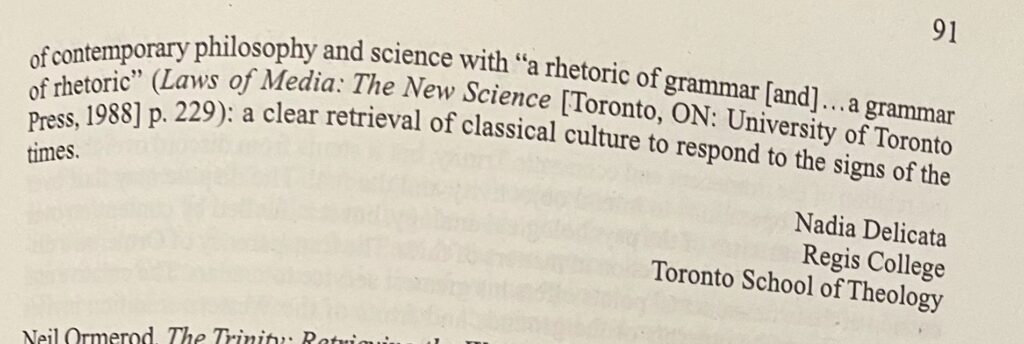
McLuhan places himself in the tradition of the humanists whose hope of reintegrating
the trivium still awaits fulfillment. His final work repeated the call for the integration
of contemporary philosophy and science with “a shetoric of grammar [and]…a grammar
of fhetoric” (Laws of Media: The New Science [Toronto, ON: University of Toronto
Press, 1988] p. 229: a clear retrieval of classical culture to respond to the signs of the
times.
Nadia Delicata
Regis College
Toronto School of Theology